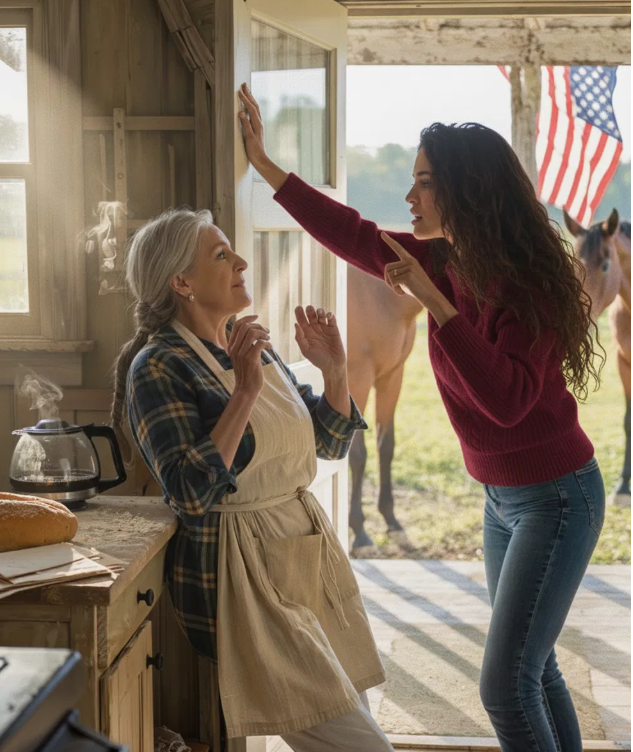
When my daughter Alexis shoved me against the kitchen wall and snapped, “You’re going to a nursing home. Or you can sleep out with the horses—choose now,” it felt like my heart splintered into a thousand pieces. Not because of her words, but because her eyes were empty—like she no longer saw me as her mother, just as some worn-out object taking up space.
What she didn’t know was that I’d been carrying a secret for thirty years, one that could change everything between us. And in that instant, I realized it was time to use the only thing I still had: the truth.
Powered by
GliaStudios
But before I get into that, make sure you’re subscribed to the channel, and tell us in the comments where you’re watching from—we love seeing how far our stories travel.
My name is Sophia. I’m sixty-two, and I spent my whole life believing a mother’s love could conquer anything. That if you gave everything—every last bit of yourself—your children would understand that love. But life showed me, harshly, that it doesn’t always work that way.
I raised Alexis on my own from the time she was five. My husband, Jim, walked out without so much as a glance back, leaving us behind with debts and a small property on the outskirts of a quiet town in Vermont. The place had a big stretch of land and a few horses Jim kept as a hobby. When he left, I considered selling it all, but Alexis adored those animals. Her little face lit up every time she touched their manes, and I couldn’t bring myself to take that away from her.
So I pushed forward. I sewed during the day and cleaned offices at night. My hands grew rough and my back ached constantly. But when I saw Alexis smile, it felt worth every sacrifice. I paid for her school, her clothes, her hopes.
When she said she wanted to study business administration in the capital, I sold the jewelry my mother left me to cover her first semester in New York City. That’s where she met George—wealthy, polished, and clearly disdainful of our simple life. The first time he visited, he wrinkled his nose at the small house, the horses, the chipped paint.
But Alexis loved him, and I wasn’t going to stand in the way of her happiness.
They married three years later, and I used my last savings to help pay for the wedding. George didn’t even thank me—just flashed that insincere smile and drifted back to his fancy friends. That was the first time I felt like I was losing my daughter—not to marriage, but to a world I could never belong to.
For a few years, things were calm. Alexis visited now and then, always pressed for time, always glancing at her watch. I pretended not to notice the widening gap between us.
Then, two years ago, everything shifted.
Jim died in a car accident and left a will. I never imagined the man who abandoned us had anything saved. But in his years away, he had built a small fortune through investments. And, for reasons I’ll never grasp, he left everything to Alexis. Two hundred thousand dollars—a small miracle for us.
When the lawyer told us, I saw something flash in my daughter’s eyes. It wasn’t happiness. It was ambition. George stood behind her with a smile that chilled me. My instincts whispered something was wrong, but I pushed the feeling aside. Alexis was my daughter—my little girl. She’d never betray me.
How wrong I was.
Three months after the inheritance arrived, Alexis and George came to my house with a proposal: they wanted to build an inn on the property. Tourism was growing, and they needed me to temporarily sign the land over to them to secure a bank loan.
A voice inside me screamed not to sign. But Alexis held my hands and, in that soft voice that always weakened me, said, “Mom, trust me. We’re going to make something wonderful here. You’ll finally be able to rest without working yourself to death.”
George chimed in, “Miss Sophia, you deserve a break. We’ll handle everything.”
And I signed. God forgive me—I signed.
Construction started two months later. They tore down the old fence, renovated the house, and built cabins in the field where the horses once roamed freely. The changes came fast and hard. And with them, Alexis’s attitude shifted too.
At first, it was small. She corrected me in front of others, ridiculed the way I spoke, criticized my clothes. Then she began treating me like an employee in what used to be my own home—ordering me to cook, clean, and wash laundry for their guests. I complied, thinking I was helping, contributing to the family business.
But things spiraled downward.
George stopped acknowledging me altogether. Alexis complained that I was taking up the best room and said they needed it for visitors. They moved me into a tiny, windowless room in the back—a glorified storage closet.
Then, three months ago, I discovered the truth.
I was looking for a document in their study when I found the property papers. My hands shook as I read them. The land, the house—everything—was officially theirs. Not temporary. Not shared. Fully theirs. They had deceived me.
I confronted Alexis that night.
She didn’t even flinch. She said, in a tone that sliced through me, “Mom, you’re old. You don’t get how this works. We did what was best. Now you have a place to live without worrying.”
I tried to argue, to remind her this was my home, built with my own sweat. She rolled her eyes and walked away. After that, the cruelty escalated.
She started calling me dead weight, a burden, an old woman clinging to the past. George laughed at her jokes about my age, my aches, my shaking hands. And still, I stayed—because she was my daughter, and a part of me kept hoping the kind little girl I raised would return.
Until that Tuesday morning.
I woke up early as always, made coffee for the guests, and cleaned the kitchen. My back hurt more than usual, but I kept working. Around ten in the morning, Alexis stormed into the kitchen like a hurricane. Her face was red with rage.
“Mom, I warned you not to touch the guests’ things!” she screamed.
I was confused.
“But I was just cleaning the room like you asked me to.”
“She smashed a vase. A vase that cost five hundred dollars. See? You’re useless now.”
I tried to explain that I hadn’t broken any vase, that maybe a guest had knocked it over, but she wouldn’t listen. George appeared in the doorway with that malicious smile I had learned to fear.
“Alexis, honey, we talked about this,” he said calmly. “Your mom is getting too old to help here. She’s getting in the way more than she’s helping.”
Alexis nodded, and then she said the words that changed everything.
“Mom, we’ve decided. Either you go to a retirement home that we’ll pay for, or you go sleep with the horses in the paddock. You choose.”
The silence that followed was overwhelming. I stared at my daughter, hoping to see even a hint that she was joking, that her threat was empty. But her expression didn’t waver. She meant every word.
Something inside me snapped then. Not my heart—that had been shattered long ago—but something else. The fear. The submission. The naive belief that things might someday improve. All of it disappeared. In its place came a cold, sharp clarity.
“Fine,” I said, my voice steadier than I expected. “I’ll go.”
Alexis blinked, startled. She must have thought I’d plead, cry, lower myself even further.
“But before I leave,” I added, “I need to make a phone call.”
I walked to my tiny room in the back—the cramped, airless space where I had been pushed aside for months. My hands shook as I dug through the old suitcase I kept under the bed. And there it was: the faded envelope I’d hidden for thirty years. Inside was a document I’d promised myself I would use only when there was no other choice.
And that moment had finally come.
I picked up my ancient cell phone—the one Alexis liked to mock as “prehistoric”—and dialed a number I’d memorized long ago but never dared to use. My heart thudded so loudly it drowned out my breathing. Three rings. Four. Then a man’s voice came on the line.
“Torres and Associates office. Good morning.”
“Good morning,” I replied, trying to control my voice. “I’d like to speak with Mr. Carlos Torres, please. It’s about the Jim Ferrer case.”
There was a pause on the other end.
“One moment, dear.”
I waited, listening to the hold music. Downstairs, I could hear Alexis’s and George’s footsteps, their voices arguing about the next guests, living their lives as if I didn’t exist, as if I were just an old piece of furniture that should be discarded.
“Ms. Sophia.”
Mr. Carlos’s voice was kind, worried.
“Are you all right? It’s been so long since I’ve heard from you.”
“Mr. Torres, the time has come,” I said simply. “I need you to do what we talked about thirty years ago.”
Silence, then a heavy sigh.
“Are you completely sure? There’s no going back.”
“I’m sure.”
“Very well. I’ll prepare everything. Can you come to the office tomorrow at ten in the morning?”
“I’ll be there.”
I ended the call and sat on the edge of the bed, clutching the envelope to my chest. Inside it lay the truth I had hidden from Alexis her entire life—the truth about her father, about the inheritance she believed was a blessing, and about the decades of lies that surrounded it.
When Jim walked out on us, he wasn’t just escaping the duties of being a husband and father. He was running from a crime. My ex-husband had embezzled a significant amount of money from the company where he worked. I discovered it by chance just days before he vanished—documents tucked away in his study, bank statements from accounts I had never seen.
I confronted him that night. He panicked, insisting he only did it to give us a better life, swearing he planned to return the money. But it was already too late. His company had uncovered the theft, and the police were closing in. He fled before they could arrest him, leaving me alone with a young child and a swarm of unanswered questions.
What Alexis never knew was that the fortune her father later grew through investments had criminal origins. Her inheritance was born from stolen money. And I had proof—everything Jim eventually mailed me in a letter asking for forgiveness. He explained everything, begged me not to tell Alexis, pleaded for me to protect her from the truth.
I kept that letter. I kept every document. And I kept the secret—not for Jim’s sake, but for hers. I didn’t want my daughter to grow up knowing her father had been a criminal, or that the future she imagined for herself had been funded by dishonesty.
But now—now Alexis had used that tainted inheritance to wrong me, to take my home, my dignity, my entire life. And I was done shielding her.
I walked downstairs with a small suitcase in hand—just a few clothes and essentials. I needed nothing else from that place. Everything of real value was inside the envelope tucked into my purse.
Alexis was in the living room with George. When they spotted the suitcase, she lifted an eyebrow.
See more on the next page
Advertisement
