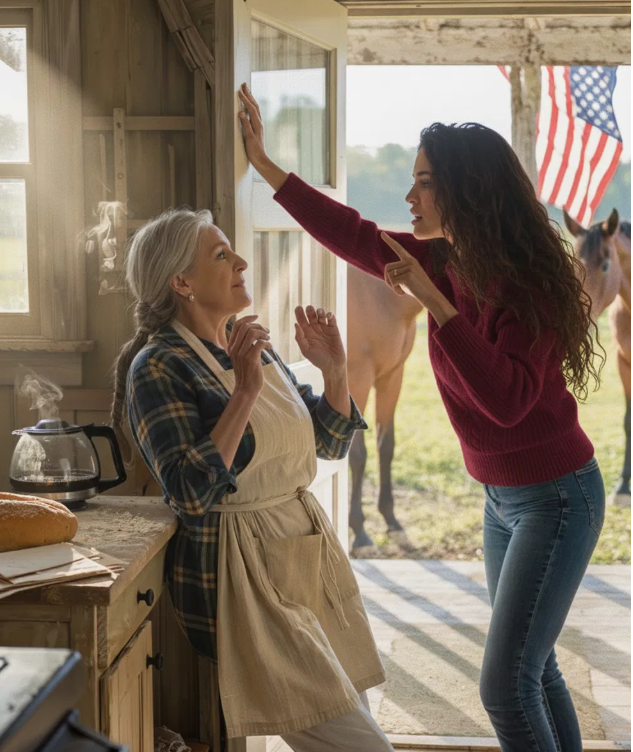
Alexis was in the living room with George. When they saw me with the suitcase, she raised an eyebrow.
“Have you decided, then? Nursing home or paddock?”
“Neither,” I replied calmly. “I’m going to stay with a friend for a few days until I sort out my situation.”
I saw the relief on her face. She probably thought I was accepting my fate, leaving their lives without making a scene. George gave that satisfied smile of his.
“Good decision, Miss Sophia. It’s for the best.”
I looked at my daughter. She avoided my gaze. And in that moment, I felt a pang of sorrow. She was still my little girl, somewhere behind that mask of coldness. But she was a girl I no longer recognized.
“Alexis,” I said softly. “Are you sure this is what you want? To throw me out like this?”
She finally looked me in the eye, and what I saw there gave me absolute certainty that I was doing the right thing. There was no remorse, no doubt—just impatience.
“Mom, stop the drama. You’ll be fine, and we will too.”
I nodded.
“All right, then. That’s how it is. But I want you to remember this moment, because in a few days you’re going to understand that choices have consequences.”
George laughed.
“How dramatic, Miss Sophia. You sound like a soap opera character.”
I didn’t reply. I just picked up my suitcase and walked out the door.
The horses neighed as I passed. I stopped for a moment and stroked the mane of Star, the oldest mare, the one Alexis loved so much as a child. The mare rested her muzzle on my hand as if she understood I was leaving.
“Take care of her,” I whispered to the animal. “Even if she doesn’t deserve it.”
I followed the dirt road until I reached the main highway. Then I called Marcy—my friend of many years—and briefly told her what had happened. She didn’t even hesitate; she said I could stay with her for as long as I needed.
That night, lying awake in the guest room at her house, sleep felt impossible. My mind kept replaying everything that had brought me to this moment. A small part of me questioned whether I was making the right choice. But then I pictured the look in Alexis’s eyes—cold, dismissive—and my resolve hardened again.
Morning came slowly. I got dressed with care, choosing my best clothes—a blue blouse I had sewn myself long ago. At nine-thirty, I boarded a bus heading downtown.
Mr. Carlos Torres’s office was located in an older building, well preserved despite its age. The receptionist recognized me immediately, even after all these years, and guided me straight to his door. Mr. Carlos looked older too—his hair now completely white—but his eyes remained exactly as I remembered: sharp, yet warm.
He rose from his chair and shook my hand firmly.
“Miss Sophia, I’m so sorry it’s come to this.”
“Me too, Mr. Torres, but I don’t see any other way out.”
He pointed to a chair and took a thick folder from the shelf.
“Very well, let’s go over everything from the beginning. When Jim Ferrer came to see me thirty-two years ago, he was desperate. He confessed to the embezzlement, handed over all the documents, and asked me to keep this as life insurance.”
“Life insurance?” I repeated, confused.
Mr. Carlos nodded.
“He was afraid the company would go after his family, so he created a document confessing everything and naming you as the sole legitimate heir to any assets he might acquire. The idea was to protect you and Alexis from future lawsuits.”
He opened the folder and began showing me documents. I recognized Jim’s handwriting on several pages, authenticated signatures, witnesses.
“But what does this mean now?” I asked.
“It means, Miss Sophia, that legally the inheritance Alexis received should have been yours. Jim left everything in her name because he thought it would be easier, less bureaucratic. But this document right here”—he tapped a specific sheet—“invalidates his will because it was made under duress, concealing the criminal origin of the money.”
I felt my head spin.
“So… so the money should have gone to me?”
“And since your daughter used that money to fraudulently acquire your property by making you sign misleading documents, we have a legal basis to reverse everything.”
“Is she going to lose the inn?” I asked, feeling a mix of relief and sadness.
Mr. Carlos paused.
“Not necessarily. It will depend on how you want to proceed. We can return the property to your name, nullifying the fraudulent transfer. As for the inheritance money, it will legally go to you. Alexis will have to return what she spent.” He looked at me seriously. “This will completely destroy the relationship between you two.”
“She already destroyed it,” I replied, my voice sounding unlike my own. “When she gave me a choice between a nursing home and a paddock, she destroyed everything that was left between us.”
Mr. Carlos spent the next two hours walking me through every step of the legal process. My mind felt overloaded with information—hearings, filings, deadlines—but one thing grew more certain with each explanation: I had full legal grounds to take back what belonged to me. I wasn’t asking for mercy. I was seeking justice.
I signed all the documents needed to begin the case. The lawyer assured me that, at first, everything would proceed quietly. Formal notices would be issued, and Alexis would be given the chance to present her side. But then he cautioned me about something that made my throat tighten.
“Ms. Sophia, when your daughter receives the summons, she will be furious, and she will probably try to find you, pressure you, maybe even threaten you. It’s important that you are emotionally prepared for that moment.”
I nodded, though fear churned inside me. I knew my daughter well—I knew exactly how she reacted when someone stood up to her. But something in me had shifted after that ultimatum. I was no longer the obedient mother willing to cling to whatever scraps of affection she threw my way. I had become a woman who was done being stepped on—and that woman wasn’t afraid to fight back.
When I left the office, I felt oddly different. My body was tense and exhausted, yet there was a surprising lightness in my chest, as if a long-carried burden had finally fallen away. For the first time in months, I felt like I was taking my life back.
Marcy was waiting for me at the corner near the building. She insisted we go to a café to talk. Over cups of coffee, I told her everything. She listened quietly, tears forming in her eyes when I described Alexis’s ultimatum.
“Sophia, you were too patient. Way too patient,” she said, holding my hand. “That girl needs to learn that a mother is not a doormat.”
“I’m scared, Marcy. Scared I’m doing the wrong thing. She’s my daughter—”
“And you are her mother,” Marcy interrupted firmly. “But that doesn’t mean you have to accept being treated like dirt. You gave her everything. You worked until your bones ached. And she responded with contempt. That’s not love, Sophia. That’s abuse.”
Her words stayed with me the entire way back.
Abuse.
It was a harsh term, but perhaps it was exactly what I had been enduring—emotional, psychological, and even financial abuse. And I had endured it in silence because I couldn’t bear to admit that my own daughter, the child I had poured so much love into, could be capable of such cruelty.
Four days went by. Four long days filled with anxiety, waiting for the inevitable explosion. Marcy did her best to keep me occupied—taking me on walks, watching movies with me in the evenings—but my thoughts always drifted back to the inn, picturing Alexis opening the legal notice.
On the morning of the fifth day, my phone rang. The number was unfamiliar. My heart sped up as I answered.
“Mom.”
Alexis’s voice sounded odd—too calm, too controlled.
“I need you to come to the house now.”
“Alexis, I—”
“No!” she shouted, and then the call was cut off.
Marcy, who was in the kitchen, looked at me worriedly.
“Was that her?”
I nodded.
“She got the notice.”
“Do you want me to go with you?”
I thought for a moment. Part of me wanted to say yes, wanted to have someone by my side, but another part knew that this was between my daughter and me. It was time to face what I myself had set in motion.
“No. I have to go alone. But thank you, friend, for everything.”
The walk to the inn felt both endless and instantaneous. By the time I stepped off the bus and started down the dirt road, my whole body was trembling. The horses stood in the paddock, calmly grazing, unaware of the storm about to break between us.
Alexis was waiting on the porch, gripping a stack of papers. Even from far away, I could tell she was livid—her face flushed, her hands balled into tight fists. George stood beside her, but for once he didn’t look smug. He looked uneasy, almost afraid.
See more on the next page
Advertisement
