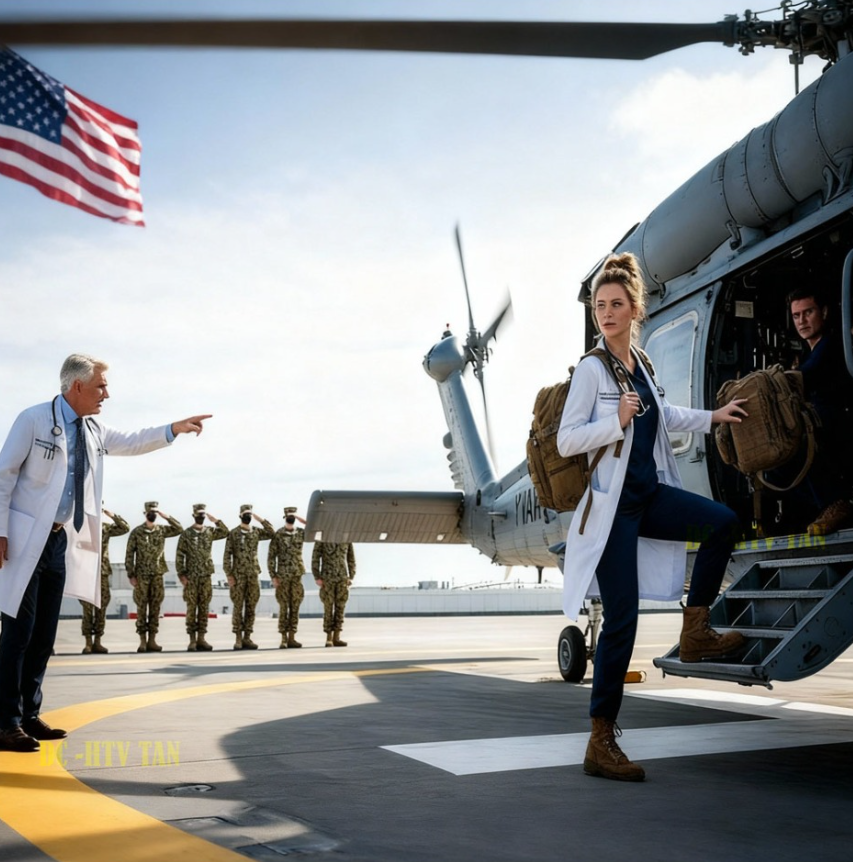
The recognition in Web’s voice was undeniable, imbued with the respect that the military reserves for exceptional soldiers. « You’re the doctor who saved those rangers at Firebase Charlie, the one who operated in the middle of a firefight. » Jake felt his perception of the situation change. He was not just a civilian doctor with some experience with trauma.
This was a man who had distinguished himself in some of the most dangerous combat operations of the war. « Sergeant Brooks, » he said in a tone of military respect. « Is Chief Webb right? » Talia took one last look around, sensing the expectation on their faces. She thought back to the life she had tried to build for herself as a civilian, to the identity she had forged for herself as a simple medical intern.
But she also thought of Lieutenant Harris, lying alive on the operating table, thanks to skills acquired only in combat. Finally, she completely removed the Navy cap that had been borrowed from her, letting her hair fall over her shoulders. Her voice, when she spoke, was different: louder, more confident, imbued with the authority conferred on her by the experience of life and death decisions made in the worst conditions.
« Yes, » she replied simply. « I’m Talia Brooks, a former Delta Special Forces combat nurse. I deployed four times to Afghanistan between 2017 and 2021. This revelation, like an evidence, radically changed the perception of the past hour for all present. She was not a civilian consultant who had benefited from a stroke of luck during a complex intervention.
She was a decorated war veteran, who had used skills learned in the world’s most dangerous combat zones to save the life of a Navy pilot. Jake found himself reconsidering everything he had observed since he had taken her to the hospital: her ease with military aircraft, her knowledge of trauma protocols, her ability to work under extreme pressure.
Everything was clear. « Sergeant, » he said, adopting a respectful tone, due to his military rank. « Why didn’t you identify yourself when we first contacted? » Talia’s expression became suspicious again. « Because I’ve turned the page, Commander. I’m a civilian now. I’ve been following him for four years. I came to Memorial Hospital for a fresh start, to practice medicine in a normal environment where the biggest crisis is internal power plays, not mortar fire. »
« But you have been able to maintain your skills at an irreproachable level, » observed Dr. Martinez. « What you did with Lt. Harris was not luck. It was the result of expertise cultivated by practice. « There are things you don’t forget, » Talia whispered. « Even when we want to. » Lieutenant Harris had listened to this exchange with growing amazement. « You were really the nurse who saved us in Red Dawn. I can’t believe it. »
My mother sent you a letter through the Red Cross after I told her what had happened. Have you received it? « I’ve received a lot of letters, » Talia said softly. They meant more to me than you can imagine. The emotion of the moment was interrupted by the crackle of Jake’s radio: a transmission came from the bridge. Commander Rodriguez, this is the bridge.
We were ordered to transport Lieutenant Harris immediately to the Naval Hospital at Baloa. Can you confirm his state of health for transport? Jake turned to Talia for the medical evaluation. She checked Harris’ vital signs one last time. His gestures retained the precision that had impressed everyone. His condition is stable and he can be transported.
She announced that paricardioentesis had been successful, but that it required surgical repair of the underlying heart injury. Balboa Hospital has the necessary facilities to perform this procedure properly. While the medical team prepared Harris for his transfer to the helicopter, Jake took Talia aside to speak to her privately. « Sergeant Brooks, I have to ask you something. »
Do you plan to resume civilian medical activity after that? The question surprised her. It was planned. Yes, even if I’m not sure if I still have a job. What if I told you that the Navy is looking for someone with your qualifications? Someone with a strong combat medical background and capable of training the next generation of military doctors.
Talia studied her face carefully. « Commander, I appreciate your offer, but I left the military for a reason. I wanted another life. « I understand, but think about it. Lieutenant Harris is alive today because of your availability when we needed you. How many other military personnel could benefit from your experience and training? Before Talia could answer, Chief Webb approached them, « Excuse me, Commander, but I couldn’t help but hear your conversation. » »
« Sergeant Brooks, if you are thinking of returning to military medical service, you should know that your reputation in the Special Forces is legendary. Many owe you their lives. This praise made Talia uncomfortable. She had never sought recognition for her military service, preferring to let her actions speak for themselves.
But hearing those words from his fellow soldiers, who understood the context of his work, had a resonance that the praise of civilians could not match. As they prepared to leave the Abraham Lincoln, Tahlia thought back to the path that had led her to that moment. Four years earlier, she had left the army, physically and morally exhausted by too many deployments, too many life-and-death decisions, too often forced to choose between saving one life and trying to save another.
She had chosen civil medicine because she thought it would be simpler, cleaner, more direct. But the events of the day had shown her that the skills she learned in the combat zone were not something she could simply put aside. They were an integral part of her identity, of what made her an effective doctor. During the helicopter flight back to San Diego, Jake continued their conversation about his future prospects.
Sergeant, how about a position that combines your military experience with your civilian medical training? A position that would allow you to save lives without having to return to combat. What type of position is it? Military Medical Advisor. You would work with combat doctor training programs, participate in the development of new trauma protocols, and provide expertise on cases requiring your level of expertise.
Based at the Balao Naval Hospital, but with the opportunity to work with all branches of the military, the offer was tempting, but Talia had spent four years trying to detach herself from her military identity. « Commander, I’m flattered, but I’m not sure I’m ready to go back to this world. »
What if the world needed what you have to offer? The question hovered between them as the helicopter approached Memorial Hospital. Below, Tahalia saw teams of journalists set up in the parking lot, attracted by the reports on the military emergency. Her quiet life as an anonymous resident would soon come into the spotlight.
As they landed on the roof of the hospital, Tahalia realized that whatever her decisions about her future were, her secret was now out in the open. The woman who had tried to disappear into civil anonymity was going to find herself in the spotlight. The helicopter landed on the roof of Memorial Hospital with the same precision it had demonstrated a few hours earlier.
But everything had changed. News of the military emergency had spread throughout the hospital and teams of journalists had gathered in the parking lot below. Their cameras were trained on the building. As she stepped off the plane, Talia spotted the crowd that had gathered on the lower levels of the hospital.
Staff members pressed against the windows. Patients and visitors had gathered in the lobby, while security guards struggled to contain the growing chaos. Commander Rodriguez accompanied him to the entrance of the stairwell. « Sergeant Brooks, know that this situation is going to attract attention. The Navy will handle media requests, but your role in rescuing Lieutenant Harris will not be kept private. »
Tahalia pulled the Navy cap she had been lent over her hair, even though she knew it was probably too late to remain anonymous. « I understand, Commander. I’ve already experienced similar situations with the media. The context was different, however. Jake pointed out that military operations benefit from built-in information security. Civil emergencies, on the other hand, were generally more public. As they descended the stairs to the main floors of the hospital, they could hear the hubbub of conversation and activity echoing through the building.
The daily hospital had been completely turned upside down by the dramatic events of the afternoon. Dur Mitchell intercepted them near the elevators, but his attitude had changed drastically since their previous altercation. Behind him stood several other directors, all visibly shocked by this information which contradicted the image they had of their former employee.
« Dr. Brooks, » Mitchell began in a controlled voice, but devoid of the arrogance he had displayed before. Commander Rodriguez informed me of your past. I think we need to have a serious discussion about what happened today. « Sir, » Talia replied in a calm voice. I think I resigned before leaving with the commander. »
There should be nothing to discuss. In reality, there is a lot to say. Mitchell’s tone was significantly more respectful than it had been a few hours before. The hospital’s board of directors has been in an emergency meeting for an hour. We received calls from the Pentagon, the Navy Department, and three different media outlets.
Your actions today have created a serious situation. Jake stepped forward. Dr. Mitchell, if formal military issues arise, they should be directed to the Navy. Commander, it is no longer just a question of military matters. Dr. Brooks performed life-saving surgery this morning, was fired for violating the rules, and then it was discovered that he was a decorated veteran whose skills had saved a pilot’s life.
The consequences are staggering. Admitting his mistake was obviously difficult for Mitchell, but the events of the afternoon had forced him to face the facts: his judgment had been catastrophic. During their conversation, Emily Chen approached the group. She waited by the elevator, obviously hoping to be able to talk to Talia in private. « Doctor… »
« Brooks, » Emily said cautiously, aware that the conversation was overheard by the hospital administration. « There are some things you should know about what happened here while you were away. » « What kind of thing? » Emily gave Dr. Mitchell a nervous look before continuing. « The patient you operated on this morning, Mr.
Gerald Patterson. His family has been there since the whole afternoon. When they learned of your military past, they wanted to meet you personally. The Patterson family is in the waiting room, Mitchell added, in a much less casual tone than before, as well as several other families of patients you cared for during your residency.
The news of your past experience spread quickly. Talia felt a familiar discomfort with the audience’s attention. One of the reasons she chose civilian medicine was to avoid the notoriety that sometimes came with military service. She wanted to help people discreetly, anonymously, without her personal story being mixed up with this story.
The administrative discussion was interrupted by the arrival of a man in Navy uniform, who had apparently taken the elevator from the main lobby. He approached their group with the air of a superior officer. « Commander Rodriguez, » the newcomer asked. « Yes, sir. Captain Michael Torres, Commanding Officer of Balboa Naval Hospital. »
« I must speak to you and Dr. Brooks at once about Lieutenant Harris’s condition and the operation performed at sea. » Jake sat up. « Yes, sir. How is the lieutenant? He is currently in the operating room. The cardiac operation went well and the surgical team confirmed that the paricecocentesis performed on board had saved his life. »
Without this intervention, he would not have survived the transport to a suitable facility. Captain Torres turned to Talia. « Dr. Brooks, I understand you saved my pilot. » « Sir, I just did the right thing. Any qualified trauma specialist would have made the same decisions. »
In fact, no, they couldn’t. Torres’ voice carried the authority of someone accustomed to saying things unequivocally. I have reviewed the ship’s medical reports. The procedure you performed required skills and experience that very few civilian doctors have. In particular, Dr. Martinez pointed out that your technique was in line with advanced military trauma training.
Legal advice on medical malpractice has become essential for healthcare professionals subject to disciplinary measures. Specialized legal services now offer a tailored defense to health professionals in crisis situations. Dr. Mitchell had followed this conversation with growing uneasiness. It became impossible for him to ignore the reality of his error of judgment.
Captain Torres, are you insinuating that Dr. Brooks’ dismissal this morning may have been unjustified? I am simply saying that Dr. Brooks appears to possess medical qualifications that are not in his professional record. The question is why your administration was not aware of it. This accusation hovered as an indictment of Mitchell’s leadership.
Talia realized that her strict separation between her military and civilian identity created unforeseen complications. By concealing her combat medical experience, she had unintentionally given the impression that the hospital had not properly assessed her skills. « Captain, » she says cautiously, « my military service was not relevant to my position as an intern. »
I didn’t mention it in my application because I wanted to be evaluated based on my civilian medical training. However, your military experience is directly related to your medical skills. Torres pointed out, « Coma first responders receive far more trauma training than most civilian doctors. This is clearly an asset for your qualifications. »
Jake followed this discussion with a growing understanding of its wider implications. « Sir, I think we are facing a bigger problem. If Dr. Brooks worked as a civilian intern without his military medical qualifications being recognized, it risks being vastly underutilized in the health care system. »
That’s exactly what I thought. Commander Torres turned to Talia. Dr. Brooks, how many former military medical personnel do you think are working in the civilian health sector without having their combat experience properly recognized? The question caught Talia off guard. She thought her situation was unique, but now she realized that other veterans could face similar challenges in getting their military skills recognized in civilian life. I don’t know sir.
I have always tried to dissociate my military background from my civilian career. What for? This seemingly simple question called for a complex answer. Talia glanced around, observing the group of people waiting for her answer. Officers who understood his commitment, hospital directors who tried to understand their serious error in judgment, and civilian medical personnel who sought to understand how they could have missed such important qualifications.
Sir, military medicine and civilian medicine are two very different worlds. In a combat zone, decisions are made quickly with limited resources and risks that civilian hospitals cannot tolerate. I thought it would be easier to start from scratch, to learn civilian protocols without my military experience interfering with my training.
« But your military experience didn’t hurt your civilian training, » Chen said. « It has enriched it. All the doctors who have treated you have highlighted your exceptional calmness under pressure, your surgical skills and your ability to make quick decisions in an emergency situation. Dr. Mitchell nodded reluctantly, his previous arrogance giving way to obvious regret. « That’s true. »
Your performance reviews have always highlighted your exceptional skills in trauma management. We thought it was a natural talent combined with extensive study. « It wasn’t a natural talent, » Talia said in a calm voice. « It was the experience of four deployments in treating war wounds in extreme conditions, but I didn’t think that experience would be valued in a civilian hospital. »
The conversation was interrupted by the arrival of an elderly man accompanied by a middle-aged woman, both of whom seemed to have been waiting impatiently for hours. Emily Chen recognized them immediately. « They’re Mr. Patterson’s son and daughter-in-law, » she explained softly. « The family of the patient you operated on this morning. »
The man approached Tilia directly, his eyes filled with gratitude and emotion. « Dr. Brooks, I’m Robert Patterson. I wanted to thank you for saving my father’s life. Talia felt uncomfortable with these direct compliments. « Mr. Patterson, I am glad that your father is well. Any doctor would have done the same thing. « No, they wouldn’t, » the woman next to him replied firmly.
I’m Susan Patterson, Robert’s wife. I am also a retired nurse. I was present at Gerald’s surgery and saw what happened. The other doctors were hesitant, concerned about the protocols and procedures. You acted immediately to save his life. Robert Patterson continued, giving Dr. Mitchell a meaningful look. Dr. Brooks, when we learned of your military commitment, everything became clear.
My father is a veteran of the Korean War. He would be proud to know that another veteran saved his life. The emotional weight of the family’s gratitude was difficult for Talia to handle, but it was also a powerful refutation of Mitchell’s earlier contempt for his actions. « Thank you, » she says simply. « I’m honoured to have been able to help. »
As the Patterson family drifted away, Captain Torres resumed the conversation about the wider political implications. « Dr. Brooks, I would like to make you a proposal. The Navy is developing a new program called the Medico-Civil Gateway Initiative. We are looking for experienced medical veterans to act as a liaison between the military and civilian health systems. »
What would this consist of? Train civilian medical personnel in war trauma techniques, advise on emergency preparedness, assist veterans in exercising their military medical skills in the civilian sector, and serve as a resource person for cases requiring your specific expertise. Commander Rodriguez added, « The position would be based at Baloa Naval Hospital, but you would be working with civilian institutions throughout Southern California. »
« It’s an opportunity to put both your military experience and your civilian training to good use. » The offer was more complex than the simple choice between military and civilian medicine that Talia faced. It would be a novelty, a way to honor both aspects of one’s professional identity without having to choose between them. But before she can answer, Dr. S…
Mitchell spoke, his voice no longer betraying any hostility. « Dr. Brooks, before you make a decision about military posts, you should know that Memorial Hospital would also like to offer you a position. » The words stuck in his throat, but he forced himself to continue.
Director of Trauma Emergency Services. This is a newly created position that would value your advanced trauma skills and give you the authority to implement new emergency protocols. The board of directors has already approved the position and a substantial salary increase. Emily Chen seemed stunned by Talia’s sudden turn of events.
This morning, you were fired for non-compliance with the protocol. This afternoon, we are offering you director positions. This is a record, no doubt. But the most spectacular turnaround was yet to come. Dr. Mitchell’s phone rang and his face broke down as he listened to the caller. It was the hospital’s legal department.
He announced, his voice barely controlled, « They have received a notification of an official investigation from the state medical board regarding my dismissal of Dr. Brooks. Apparently, the media coverage has triggered a reconsideration of our personnel decisions. Captain Torres nodded somberly. « Dr. Mitchell, I must inform you that the Defense Health Agency will also be conducting its own investigation into the recognition of veterans’ medical qualifications in civilian institutions. »
Your hospital’s handling of Dr. Brooks’ case will no doubt be the subject of a case study. The weight of institutional scrutiny was clearly overwhelming for Mitchell. His former confidence had given way to the certainty that his career was now in jeopardy. « Dr. Brooks… he whispered.
I owe you an apology. I made serious errors in judgment today. I have let my respect for protocol take precedence over the recognition of your exceptional skills. This apology, public and humiliating to Mitchell, was exactly the kind of responsibility that the public was clamoring for. But the consequences were just beginning.
Emily Chen revealed information that would further aggravate Mitchell’s situation. Dr. Mitchell, there’s something else you need to know. The nursing staff has filed a formal complaint regarding Dr. Brooks’ termination. We have identified several cases where hospital policies have prevented optimal patient care and we are calling for a comprehensive review of emergency protocols.
The rebellion of the staff dealt the final blow to Mitchell’s authority. His own men turned against him, united by their respect for Talia and their frustration with her unyielding command. Next week’s story features an underrated Marine until the enemy attack on its base. Not to be missed! Jake looked at his watch and realized that several hours had passed since Lt. Harris’ emergency operation began.
Captain Torres, do we have any news of the pilot? Torres checked his phone. The operation went well, the heart damage was fully repaired, without complications. He should make a full recovery and take over the reins within six months. This news visibly relieved everyone in the group, but it also confirmed the effectiveness of Talia’s intervention, which had saved her life.
« Sir, » Talia said to Captain Torres, « I would like to visit Lieutenant Harris as soon as he can receive visitors. I want to make sure that his recovery is going well. I think he would appreciate it, Dr. Brooks. But I must warn you, his story will arouse a lot of media interest. A Navy pilot rescued by a decorated veteran: that’s a headline that makes headlines. »
The media attention was already starting to have real consequences for Dr. Mitchell. His assistant approached with news that made him turn even more pale. « Dr. Mitchell, the hospital board of directors is asking you to attend an emergency meeting immediately. They want to discuss the day’s events and your future role at the facility. »
The summons was clearly disciplinary, and Mitchell knew it. The dismissal of a decorated veteran had caused an image disaster, threatening the hospital’s reputation. Captain Torres presented Talia with a formal offer: « Dr. Brooks, I am authorized to propose to you a direct appointment to the rank of Lieutenant Commander in the Navy Reserve, as well as the position of Director of the Civilian Medical Transition Initiative. »
You would be responsible for developing protocols that could save thousands of lives. Sir, this is a generous offer, but I need time to think. It was a particularly trying day, of course, but agreeing would mean working closely with the parliamentary committees responsible for veterans’ health policies.
Your experience could influence legislation affecting millions of veterans. As the sun set over San Diego, the consequences became obvious. Dr. Mitchell’s career was well and truly over. The hospital would implement the Brooks Protocol for emergency situations, prioritizing patient care over administrative procedures.
Mitchell returned from the board meeting with a pale face. « The council has accepted my resignation, » he announced calmly. « It takes effect immediately. Dr. Brooks, firing you today was the worst decision of my career. You are exactly the kind of doctor this hospital needs. This public declaration brought the justice that the public demanded.
The man who had shattered careers by his rigid respect for protocol was finally suffering the consequences. « Commander Rodriguez, » said Talia at last, « I think I am ready to stop hiding. » Jake smiled. « What does that mean, Sergeant? » « This means that I accept Captain Torres’ offer. It is time to build bridges rather than walls. »
Talia finally understood that her two identities, a military nurse and a civilian doctor, were not contradictory, but complementary. Lieutenant Harris appeared in a wheelchair, conscious despite a recent operation. « Sergeant Brooks, I wanted to thank you personally. The doctors told me that I would not have survived without your intervention. « Lieutenant, I’m just glad you’re okay. »
There is something else. Your actions today have been reported to the highest levels of military command. We are talking about a distinction for your services. Emily Chen came to bring us the latest information. Dr. Brooks, the Patterson family has started a petition to have the new emergency protocol named after you. It was a touching gesture, but Talia understood that the true tribute would be the lives saved by veterans whose military medical experience was finally being recognized and valued in the civilian health care system.
Some wars never end, she thought. They are only changing the battlefield. Sometimes the most important battles are won not with weapons, but with the know-how to care for the wounded and the courage to build bridges between different worlds. For the first time in four years, Dr. Talia Brooks, aka Sergeant Brooks, was ready to fight this fight with all her might.
« Dr. Brooks, you are fired. » These words echoed through the emergency department of Memorial Hospital as Dr. Talia Brooks stood over the old man whose heart she had just revived with her bare hands. « You are performing surgery without authorization. » « He was dying, » Talia whispered, blood still on her gloves. « Leave immediately before I call security. »
The 1.63 m tall resident crossed the corridor in silence, her colleagues avoiding her gaze. Some whispered behind his back. Others shook their heads, regretting their actions. She had saved a life and lost her career at the same time. But when she reached the parking lot, the deafening rumble of helicopter blades shattered the afternoon calm.
A Navy helicopter descended toward the roof of the hospital, its gray wing blocking the sun. The security guards dispersed. Patients pressed against the windows. From the cockpit, Commander Jake Rodriguez stepped out, his voice piercing the chaos. « I need Dr. Talia Brooks right now. » A nurse frantically pointed to the parking lot. « She has just been fired. »
« Get her back here immediately! » barked Jake into his walkie-talkie. « A pilot fell into the sea. Severe chest trauma. We need a combat medic, and there is only one qualified person within 500 yards. The same woman they had just fired for saving one life would become their only hope of saving another.
What they didn’t know was that Talia Brooks had much more than medical knowledge. She held secrets that would turn everything upside down. Sitting in her battered Honda Civic, her hands shaking on the steering wheel, the adrenaline of the emergency operation subsided, giving way to the harsh reality of unemployment.
She straightened her shoulders mechanically, a habit she had developed over the years of standing at attention, though she had never explained to her colleagues the origin of this posture. The automatic doors of the hospital opened and Dr. Harrison Mitchell appeared. His imposing stature of 1.83 m and his silver hair immediately attracted the attention of the assembled group of personnel.
Mitchell had been chief of surgery for twelve years, and his reputation for unyielding application of hospital protocols was legendary throughout the San Diego medical community. « I want everyone to understand what happened in there, » Mitchell announced, his deep voice echoing in the parking lot with the authority of someone accustomed to absolute obedience.
Brooks broke many protocols. She performed an unauthorized thoracotomy, without proper supervision, without following established procedures, and without considering the institution’s responsibility. The audience murmured, most of the people nodding in agreement. Few people took issue with Dr. Mitchell’s words. His medical expertise was unquestionable, and his political influence within the hospital system had already shattered careers.
Dr. Patricia Williams, the hospital’s executive director, stood by Mitchell’s side, visibly uncomfortable with the public nature of her statement, but reluctant to contradict the chief of surgery in front of all the staff. « Always too aggressive, » Mitchell continued, disapprovingly. « I’ve been saying it for months. »
It is reckless, even dangerous. You can’t operate on someone’s chest just because you want to. Medicine is about following protocols, not playing the hero. A young intern, at the back of the room, timidly raised his hand. But Dr. Mitchell, she saved his life, didn’t she? Mitchell’s face hardens, his gray eyes fixing on the inside with the intensity of a predator spotting its prey. That’s not the point, Doctor.
Williams. Medicine is about following protocols, not playing with patients’ lives. What if she had killed him? What if there had been uncontrollable complications? It put the entire hospital in danger. And frankly, she put your careers in jeopardy by association. The intern’s face flushed and he blended into the crowd, visibly intimidated.
Mitchell’s message was clear: to question his judgment was to take an unsustainable risk for his career. If the injustice of this hospital revolts you, you are not alone. Like and subscribe, because the rest will shock you even more than what you’ve ever seen. Meanwhile, five kilometers offshore, aboard the USS Abraham Lincoln, Commander Jake Rodriguez received the worst news.
His radio crackled urgently as the OOW’s voice pierced the interference. « Commander, we have an emergency. Lieutenant Harris crashed during a training exercise. His F-18 Super Hornet suffered an engine failure at an altitude of 60 meters. He managed to eject, but the impact was violent. »
We are talking about a massive chest trauma, possible heart damage. Jake’s jaw clenched. He had seen enough war wounds to know what massive chest trauma was. Time was crucial, absolutely vital. What is its current state? Unconscious. His vital signs dropped. Our ship’s doctor is knowledgeable, but he’s never seen anything like it. We need someone who has real medical experience in war.
Someone who had treated chest trauma in extreme conditions. Jake went through all his military medical contacts within a 500-nautical-mile radius. The Navy’s top trauma surgeon was in Norfolk. The Marines’ top field medic was deployed overseas. The Air Force specialist was in Germany. Suddenly, a memory came back to him.
A name that he had heard whispered in certain circles, always with respect, sometimes with admiration. « Brooks, » he said in a low voice, then louder into his walkie-talkie. « There’s someone at Memorial Hospital in San Diego. Dr. Talia Brooks, I ask you to prepare the helicopter immediately. His signal officer looked puzzled. « Sir, is she in the Navy? » « Just get the device ready. »
See more on the next page
Advertisement
