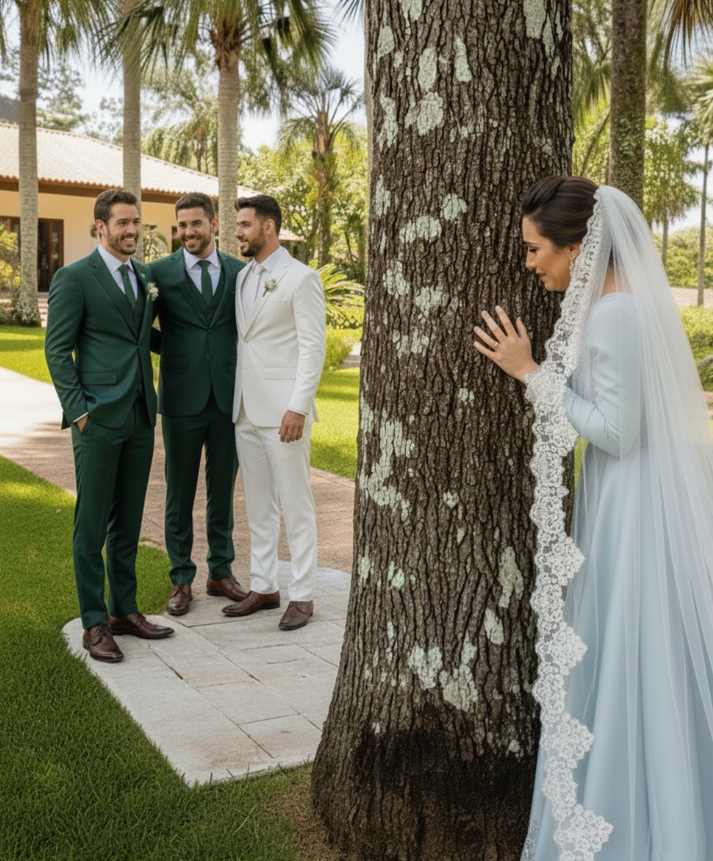
The ceremony was just minutes away when Camila Acevedo felt her legs tremble. Under a pergola draped in white bougainvillea and warm lights, in the garden of the family mansion in Valle Real, Zapopan, she adjusted her veil in front of a portable mirror. Her makeup was perfect. Her dress, impeccable. Soft music was already drifting from the open-air altar area.
In a matter of moments, she would walk toward Rafael Bravo, the man she had called “love” without hesitation for three years.
Destiny, however, decided to speak first.
Behind a group of decorative palm trees, she heard male laughter. She recognized Rafael’s voice immediately: confident, self-assured, the same voice that always calmed her… or so she thought. Curiosity drew her in with silent steps, almost breathless, her heart beating strangely.
And then… her world shattered.
“Look, buddy,” Rafael said, laughing, “this isn’t romance, it’s strategy. Don Eduardo’s company is a goldmine. As soon as I sign and they give me the authority… it’s over. I’m taking the wheel.”
Another voice responded with an admiring whistle.
“And Camila?”
Rafael let out a cold laugh.
“Camila is the door. I just need it to open.”
Camila stood motionless among the trees. The perfume of the flowers she herself had chosen for “the happiest day” mingled with a bitter, metallic taste. Her mouth went dry. Blood rushed to her ears. In her mind, like pieces of a puzzle, memories that had once seemed innocent began to fall into place: Rafael’s questions about contracts, suppliers, logistics routes; his excitement when he heard “Acevedo Transportes”; his exaggerated interest in “how the power of attorney works.”
It wasn’t love. It was a plan.
“Besides,” Rafael continued, “the old man’s getting on in years. With a little legal nudge, Camila won’t even notice. It’ll all stay ‘in the family.’”
Laughter echoed through the palm trees like applause. Camila felt that the dress, just moments before a symbol of hope, was now a lace cage.
She could run away. She could scream. She could stop everything. All she had to do was face the guests and tell the truth.
But something inside her, something new, colder and clearer, refused to give Rafael an easy way out.
Canceling the wedding would free him without consequences. And Camila understood, with a clarity that hurt, that this man wasn’t just a romantic disappointment: he was a real risk to anyone who trusted him.
She took a deep breath, straightened her shoulders, and touched her veil as if placing a crown on her head.
“If he thinks he’s won…” she told herself, “let him keep thinking that.”
She returned the same way, with firm steps, her expression never wavering. When she appeared in the petal-strewn aisle leading to the altar, no one noticed the transformation that had just taken place inside her.
To the guests, Camila was still the perfect bride: elegant, serene, a white figure framed by golden lights. But inside, she was no longer the same woman who, just minutes before, had been about to live a fairytale.
Rafael awaited her with a practiced smile. Camila held his gaze for a second longer than usual. For the first time, she didn’t see a future husband: she saw a man eager to close a business deal.
Her father, Eduardo Acevedo, offered her his arm. He was 58 years old and possessed that mixture of pride and tenderness of someone who had built everything from the ground up: a logistics company respected throughout western Mexico. When he took her arm, he whispered with emotion:
“Daughter… this is one of the happiest days of my life.”
Camila smiled, her expression unbroken.
“Me too, Dad”, I said, in a voice that betrayed nothing.
It wasn’t the time to break the heart of the man who had cared for her the most. Not yet.
The ceremony unfolded like a play Camila already knew by heart. The officiant’s words sounded ironic: commitment, truth, respect. Rafael responded to the vows with impeccable confidence, like someone signing a contract. He was a good actor. Too good.
When it was Camila’s turn, there was an emotional silence. She spoke carefully:
“I promise to walk with you… with honesty. I promise to choose what is right… even when it’s difficult.”
She didn’t lie. She simply left the phrases open, ready to take on a different meaning when the time came.
As they exchanged rings, Camila felt the weight of the gesture. It wasn’t “forever.” It was a key. And she was taking note of who wanted to use it.
After the customary kiss, applause erupted. White petals, cell phones held high, congratulations. “What a perfect couple!” they repeated.
During the photos, Rafael leaned in and whispered to her, satisfied:
“Everything is going better than I imagined.”
Camila nodded.
“Yes,” she replied. “Much better.”
And for the first time since she’d heard him among the palm trees, that wasn’t a lie.
At the reception, under a transparent tent, Camila moved among uncles, partners, and friends with almost surgical precision. She laughed, toasted, and expressed gratitude. Meanwhile, she watched Rafael from a distance: he wasn’t celebrating, he was inspecting. He approached his father’s executives, asked too many questions, analyzed routes, margins, “expansion possibilities.”
And Camila noticed something else: Rafael wasn’t just ambitious… he was in a hurry. The hurry of someone cornered.
See more on the next page
Advertisement
