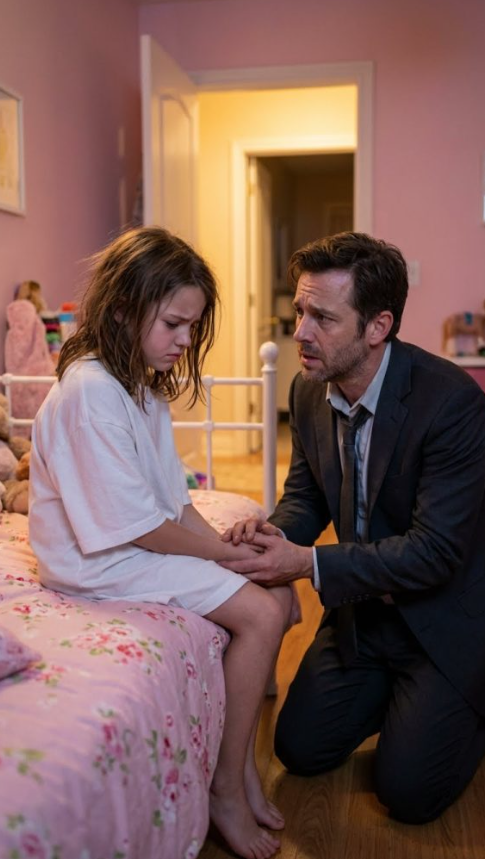
“This is madness, Adrian.” His tone wasn’t apologetic, but annoyed. “You’ve gone too far. Patricia is devastated. She says it was an accident and you made a scene with the police. Do you realize the damage you’re doing to the family image? To Valentina’s image?”
“Image?” I stood up from the armchair and went to the room’s balcony so as not to shout in front of the girl. “Fernando, your daughter let my daughter’s back rot for five days. There was pus! She had a fever! And you’re talking to me about image?”
“Patricia isn’t a doctor. She made an error in judgment, yes. But she isn’t a criminal. Listen well, Adrian. Drop the charges. Say it was a misunderstanding. We’ll pay for the best doctors, give you whatever you want in the divorce settlement, revise the alimony… But end this legal farce. If you continue, we will destroy you. We have resources you can’t imagine.”
“Are you threatening me?”
“I’m offering you a dignified exit. Think of your daughter. Do you want her mother to go to jail? Do you want her to grow up knowing her father put her mother behind bars?”
There was a tense silence. I looked through the glass. Valentina was trying to open a yogurt with one hand, focused, innocent.
“Fernando,” I said, with a calm that frightened me. “My daughter already knows who takes care of her and who hurts her. I don’t care about your money. I don’t care about your influence. Patricia is going to pay for every minute of pain Valentina suffered in that house. And if you try to threaten me again, I will record the call and hand it to the judge. Never call this number again.”
I hung up. My hands were shaking, but not from fear. They shook with pure determination. The war had begun, and I would take no prisoners.
That night, while Valentina slept again, I went online. The headline of the online edition of La Vanguardia read: High Society Scandal: Patricia Romero Arrested After Ex-Husband’s Complaint. Comments were a mix of support and poison. Some said “poor thing,” others “he probably just wants money from her,” “mothers are always right.”
I turned off the phone. The world could say whatever it wanted. I had only one mission: to heal my daughter. And the road ahead would be long, painful, and full of dangers. But looking at her face in the hospital gloom, I knew that if necessary, I would burn the entire city down to keep her safe.
Three days later, we were discharged. Not because Valentina was completely healed, but because the hospital had turned into a fishbowl. Journalists had discovered our location and were staked out at the main entrance, cameras and telephoto lenses pointed like snipers at the pediatric ward windows. Dr. Moreno suggested recovery would be better at home, away from stress, with daily visits from a home nurse to dress the wounds and administer antibiotics.
Getting Valentina out of the hospital was like a military operation. Carlos organized an exit through the basement loading dock, using one of the nurses’ cars as a distraction. I carried her in my arms, wrapped in a blanket so no one could photograph her face. I felt her stiff little body pressed against mine.
“Why are we hiding, Daddy?” she whispered against my neck.
“We’re playing spies, sweetie. It’s so those annoying photographers don’t bother us.”
When I got home, the relief was short-lived. My house, a modern villa in Sarrià overlooking the city, used to be my refuge. Now it felt like a besieged fortress. There were paparazzi at the gate of the gated community. I had to call security to get us through.
We entered, and I slammed the armored door shut. The silence of the house enveloped me again, but this time I wasn’t alone.
“Welcome back, princess,” I said, placing her carefully on the large living room sofa.
“Mommy won’t come here, will she?” she asked, looking at the large window facing the garden.
“No. No one enters here without my permission.”
The first days at home were a mix of nursing care and trench warfare. Valentina had nightmares. She woke up screaming, sweating profusely, saying “the wardrobe was eating her.” I had to start sleeping on a mattress on her floor, holding her hand through the bed frame until she calmed down.
Caring for her wound was a daily, painful ritual. Although the infection had subsided, the tissue was still tender and the wound looked shocking. Every time I removed the gauze to clean the area, Valentina cried softly, a sound that broke my heart.
“Sorry, sorry, almost done,” I told her, my heart heavy.
“It’s not your fault, Daddy,” she told me between sobs, showing a maturity no seven-year-old girl should have.
Meanwhile, outside our walls, the media storm intensified. The Romero family’s strategy was deployed with brutal efficiency. Opinion pieces began appearing in allied newspapers, with “sources close to the family” suggesting I was an unstable, control-freak man, and that Patricia was a victim of a patriarchal system criminalizing mothers for domestic accidents.
They went so far as to say Valentina had “behavioral problems” and self-harmed. When I read that in a gossip magazine sent to me, I had to run to the garden and scream until I was hoarse so I wouldn’t break anything inside the house. They were smearing a seven-year-old girl to save her mother’s reputation. It was monstrous.
But the real turning point came a week after discharge.
I was in the kitchen making chicken soup—the only thing Valentina ate without complaint—when the service door bell rang, the back door leading to the alley. I was surprised. No one used that door except staff, and I had given the cleaner time off for privacy.
I checked the security camera. It was an older woman with a headscarf and a nervous look. I recognized her immediately. It was Rosa, the housekeeper who worked at Patricia’s house. The woman who had cared for Valentina since she was born, before we divorced.
I opened the door cautiously.
“Rosa? What are you doing here? If the Romeros see you…”
Rosa practically forced her way in, closing the door behind her. She was trembling, eyes red from crying.
“Mr. Adrian, please forgive me. I couldn’t sleep. I haven’t slept for days, watching the news and seeing what they’re saying about the girl.”
“Rosa, sit down. Do you want some water?”
“No, I don’t want anything. I just want… I want to tell you the truth. Because God will punish me if I don’t speak.”
I sat her down in the kitchen. Rosa wrung her hands in her lap.
“What truth, Rosa?”
“I was there. On Tuesday. When it happened.”
I was stunned. Valentina hadn’t mentioned Rosa.
“I thought it was Rosa’s day off,” I said.
“No, sir. I was in the kitchen ironing. I heard the screams. Mrs. Patricia was… she was out of her mind. She was screaming horrible things about how the girl was ruining her figure, that she was a burden. And then I heard the crash. It was a loud, dry thud, like a sack of potatoes hitting wood. And the girl’s scream… Oh, sir, I’ll never forget that scream.”
Rosa began to weep openly. I put a hand on her shoulder, encouraging her to continue. This was crucial. We had an eyewitness. Or at least, an earwitness.
“I ran upstairs,” Rosa continued between sobs. “I went into the room. The girl was on the floor, crying, clutching her back. Mrs. Patricia was standing there, huffing and puffing, face red with rage. When she saw me, her expression changed. She yelled at me to leave, saying nothing was wrong.”
“Did you see the wound?”
“Yes. The woman lifted her shirt and I saw how swollen it was. I told her: ‘Ma’am, we need to put ice on it, we need to call a doctor.’ And she… she grabbed me by the arm and took me to the hall. She told me if I said a word, I was fired. That she would make sure no one else hired me in Barcelona. That I would be deported back to my country, even though she knew my papers were in order.”
Patricia’s cruelty knew no bounds. She had threatened a vulnerable employee to cover up her abuse.
“Rosa, why did you leave? Why did you leave her alone?”
“I didn’t leave, sir. She fired me. That same night, she told me to take the week off, that she would handle everything. She gave me 500 euros in cash and told me to disappear until you came back. I… I was scared. I need the job; I support my mother in Ecuador. I am a coward.”
“No, Rosa. You are not a coward. You are just another one of her victims. But now you are here.”
“I saw on TV they’re saying the girl fell on her own. That’s a lie. And I can’t let the girl be called a liar. I’m willing to talk. To the police, to the judge, to anyone. Even if Mrs. Patricia ruins me.”
I felt a wave of gratitude so great I hugged that woman right there in the middle of my kitchen.
“She won’t ruin you, Rosa. I promise. Carlos will protect you. And if you get fired, you’ll work for me. But I need you to tell this to my lawyer today.”
That same afternoon, Carlos came to the house and recorded Rosa’s sworn statement. It was the missing piece. We had the medical report, the victim’s testimony, and now, a neutral witness corroborating the violence and subsequent coercion.
But the psychological war didn’t end there. Two days before the custody hearing, a package arrived at my house. No sender. Inside was a velvet box. I opened it carefully.
It was a lock of blonde hair. Valentina’s hair, from when she was a baby, tied with a pink ribbon. And a note written in Patricia’s perfect, angular handwriting:
“She will always be mine. No judge can cut the umbilical cord. If you take her from me, you will regret it every day of your life. I know where you sleep.”
It was a direct, visceral threat, typical of a disturbed mind. My blood ran cold. How had she managed to bypass security to send that? Carlos took the note to add to the file as proof of harassment and violation of the restraining order (even if indirect), but fear settled in me.
That night, I installed two more security cameras and hired a private bodyguard to watch the door 24/7.
Valentina noticed my tension. We were watching a Disney movie in the living room, trying to have a normal evening.
“Daddy? Why is there a big man at the front door?” she asked.
“He’s a friend, sweetie. He came to make sure no one bothers us.”
“Is it because of Mommy?”
I couldn’t lie to her. Not after everything we’d been through.
“Yes. Mommy is… very angry because we told the truth. And sometimes, when people are angry, they do silly things. So the big guy is here to make sure Mommy doesn’t come yelling.”
Valentina snuggled into me.
“I don’t want her to come. I like being with you. My tummy doesn’t hurt here.”
“Your stomach doesn’t hurt here?”
“No. With Mommy, I always had aches before dinner. Because I was scared I’d do something wrong, stain the tablecloth, or not eat fast enough. With you… with you I breathe better.”
That sentence, “With you I breathe better,” was the fuel I needed to face what was coming. The trial. The final confrontation. I no longer feared the Romeros or their lawyers charging a thousand euros an hour. I had the truth on my side, I had Rosa, and I had the unconditional love of a girl who was finally starting to heal.
I looked out into the darkness of the garden, where the bodyguard’s silhouette stood out against the streetlights. Let them come, I thought. Let them come with everything they have. Because this time, the “absent” father was more present than ever, and armed to the teeth with the truth.
The day of the hearing dawned with one of those leaden grey skies typical of Barcelona when the sea decides to bring humidity and melancholy. The City of Justice, that complex of cold modern buildings on Gran Via, loomed like a concrete and glass giant.
I arrived early with Carlos. We had decided Valentina wouldn’t come. The judge agreed, thanks to psychological reports, that her testimony could be pre-recorded in a safe environment (the Gesell dome) to prevent re-victimization by confronting her mother in a cold courtroom. It was better this way. I didn’t want her to see Patricia transformed into a cornered beast.
The entrance was swarming with journalists. Camera flashes went off like lightning as we exited the car.
“Mr. Romero! Is it true you manipulated the maid?” “Adrian! What do you think of your father-in-law’s statements calling you a gold digger?”
I ignored the questions, walking eyes fixed forward, shielded by my lawyer’s bulky frame and two court security officers.
Inside, the atmosphere was more sterile but equally tense. In the investigating court hallway, I saw the Romero clan. They were all there: Fernando, Patricia’s mother (looking at me like I was trash), and Patricia.
She was dressed in black, no makeup, hair in a low ponytail. A carefully constructed image of humility and suffering. She looked smaller, more fragile. If I didn’t know her, if I hadn’t seen what she was capable of, I might almost feel sorry for her. But then she lifted her gaze and our eyes met. And there was no humility there. There was an icy, calculating glint. She held my gaze for a second then turned to her lawyer, the renowned criminal defense attorney Garrigues, a man with a reptilian face and a three-piece suit.
We entered the courtroom. The judge was a woman, Magistrate Soler. She had a reputation for being strict, not swayed by last names or crocodile tears. That gave me a sliver of hope.
The hearing began. Garrigues, Patricia’s lawyer, attacked first. And he was brutal.
“Your Honor, this is a classic case of parental alienation,” he said theatrically, pacing the court. “Mr. Romero, bitter over the divorce and jealous of the custody my client held, took advantage of a minor domestic accident to construct a terrifying narrative. He manipulated an impressionable child, bribed a maid fired for theft—there was the lie about Rosa—and exaggerated medical reports to destroy an exemplary mother.”
They presented photos of Patricia with Valentina at Disneyland, at her birthday party, smiling. Perfect photos.
“Look at these photos. Do you see an abused child? No. You see a happy child. What happened Tuesday was an accident. The child got hurt. The mother, scared but loving, tended to the wound. Perhaps she didn’t go immediately to the hospital for fear of the disproportionate reaction of her ex-husband, who always threatened to take the child. It was a lapse in judgment, yes, but not a crime.”
I could barely breathe listening to such masterful lies. It sounded plausible. If you didn’t know the truth, you’d believe it.
Then it was Carlos’s turn. My lawyer didn’t get up to pace. He remained seated, serious, and began shuffling papers.
“Your Honor, the defense speaks of narratives. We speak of clinical facts. I call to the stand Dr. Javier Moreno, head of pediatrics at Sant Joan de Déu Hospital.”
Moreno’s testimony was precise. He projected photos of Valentina’s back onto the court screen. Muffled gasps ran through the audience and officers. Even Judge Soler frowned visibly.
“Doctor,” Carlos asked, “is it possible these injuries are the result of a simple fall as the defense claims?”
“Absolutely not,” Moreno replied firmly. “The lumbar contusion indicates high-energy impact against a blunt, protruding object, consistent with the handle described by the girl. But the most conclusive evidence is the marks on her arms. They are fingerprints. Digit impressions. Someone grabbed her with violence. A fall does not leave fingerprints symmetrically on both arms.”
“And the infection?”
See more on the next page
Advertisement
