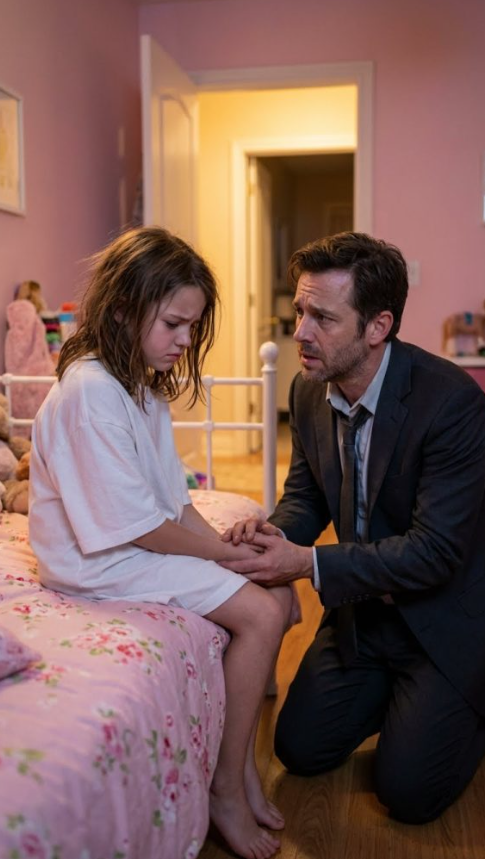
“I returned from a trip and found my 7-year-old daughter hiding a painful secret under her clothes: what I discovered forced me to send her mother to prison and fight for her life.”
The flight from Tokyo had been endless. Fourteen hours trapped in a pressurized metal can, crossing time zones, my mind numbed by exhaustion and a strange sense of unease that hadn’t left me since I took off from Narita. The taxi driver taking me from El Prat airport to my home in the upper district of Barcelona chatted animatedly about the latest Barça match, but I could barely nod, watching the plane trees of Avenida Diagonal flash by in blurs of green and grey through the window.
I just wanted to get home. I wanted to take a shower, peel off this suit that felt like a dirty second skin, and above all, I wanted to hug Valentina. My little Valentina. I had been gone for a week, an eternity in the time of a single father—or almost single, considering the disaster that was my divorce from Patricia. The taxi stopped in front of the wrought-iron gate of the house. I paid, grabbed my suitcase, and took a deep breath of the hot, humid Barcelona air.
Upon entering the hallway, the silence of the house struck me. It wasn’t a peaceful silence, but a dense, heavy stillness, like the air before a summer storm.
“I’m home!” I shouted, trying to inject some energy into my voice.
I expected to hear the patter of Valentina’s bare feet running down the hall, her laughter, that scream of “Daddy!” that usually dissipated all the stress of my travels. But nothing. Just the echo of my own voice reverberating off the cold marble.
Then I saw her. Patricia was descending the main staircase, but not with her usual calm. She walked quickly, almost stumbling, her designer bag over her shoulder and car keys jingling in her hand. She looked impeccable, as always: perfect makeup, salon-waved blonde hair, a dress that probably cost more than many families earn in a month. But there was something in her eyes, a fleeting flash of nervousness she tried to hide behind a forced smile.
“Oh, Adrian, you’re early,” she said without stopping, breezing past me like a gust of expensive perfume and coldness. “Look, I’m terribly late for my appointment at the salon. Valentina is in her room.”
“Wait, Patricia,” I tried to interrupt, confused. “Can’t you stay five more minutes? I just got back from Japan. How is the baby? How was her week?”
“She’s fine, she’s fine, everything is fine. You know how she is, relax.” She averted her gaze, rummaging for her sunglasses with suspicious urgency. “Seriously, Adrian, they’ll cancel my appointment if I don’t hurry. We’ll talk later.”
And without another word, she walked out the front door. I heard the car engine roar and speed away. I stood there, suitcase in hand, frowning. Patricia could be many things—vain, selfish, distant—but she usually stayed at least ten minutes to brag about what a “good mother” she had been or to complain about some mischief Valentina had gotten into. This hasty departure wasn’t normal. It was an escape.
My paternal instinct, that invisible radar all parents develop, began flashing red. I left my suitcase in the hall and took the stairs two at a time.
“Valentina?” I called softly as I reached the upstairs hallway.
Her bedroom door was ajar. I pushed the white wood, and the scene that unfolded chilled me to the bone.
My daughter wasn’t playing with her dolls. She wasn’t drawing. She was sitting on the edge of the bed, her back to me, motionless. She was wearing an old, baggy white t-shirt that looked two or three sizes too big. Her shoulders were hunched in a rigid, unnatural posture, as if she were protecting her body from an invisible blow.
“Valentina, my love,” I whispered, entering slowly.
She turned her head slowly. Her large dark eyes were rimmed with violet circles, not from makeup, but from sheer exhaustion. There was no joy in her gaze, only cautious relief and a lot of fear.
“Daddy…” her voice was a fragile thread.
“Come here, princess. Daddy missed you so much.”
I approached with open arms, hoping to lose myself in the hug I had dreamed of all week in Tokyo. She stood up with slow, almost robotic movements, like an elderly person with arthritis rather than a vibrant seven-year-old girl. She walked toward me, and when my arms wrapped around her, pulling her to my chest, it happened.
“Oh! No, Daddy, no!” she cried out.
It was a sharp, piercing scream, full of real physical pain. I released her immediately, recoiling as if burned.
“What is it?” I asked, my heart racing. “Did I hurt you? Where does it hurt?”
Valentina hugged herself, tears instantly welling in her eyes and rolling down her pale cheeks.
“My back… my back hurts so much, Daddy,” she sobbed.
“Your back?” I knelt to be at her eye level. “What happened? Did you fall?”
She shook her head, looking at the floor. Her lower lip trembled.
“Mommy said it was an accident… but it hurts a lot. I haven’t been able to sleep on my back for three days.”
“Three days?” I repeated, feeling confusion give way to alarm. “Valentina, look at me. What kind of accident?”
She didn’t answer. She seemed to be fighting an internal battle, her eyes darting side to side as if looking for an exit.
“My love, you can tell me everything. I am your father. I am here to protect you. No one is going to hurt you if you tell me the truth.”
“Mommy said…” she began, and had to take a deep breath to continue, as if the words physically weighed on her, “Mommy said if I told what happened, she would say I was lying. She said you would believe her because… because adults always believe other adults instead of children.”
That sentence. That damn sentence changed everything. It was the exact moment the situation went from a concern to an emergency. Patricia had manipulated my daughter’s mind, using her authority to silence her. I felt heat rise up my neck, but I forced myself to stay calm. If I lost control now, I would scare Valentina even more.
“Listen very carefully, Valentina,” I said in a firm but gentle tone, holding her cold little hands in mine. “That is a lie. I will always, always believe your word over any adult’s, including your mother’s. You are the most important thing. Now, please, tell me the truth. What happened on Tuesday?”
Valentina looked at me, searching for the truth in my eyes. And she found it. She took a deep breath, a shuddering sigh that seemed to empty her lungs.
“It was at dinner. Mommy got really mad because I didn’t want to eat broccoli. You know my tummy hurts when I eat broccoli, Daddy, I promise, it wasn’t just being picky.”
“I know, honey, I know. We know you have intolerance to certain vegetables. Go on.”
“She yelled. She said I was making excuses. She sent me to my room without dinner. I was hungry and I went upstairs crying.”
She paused, swallowing hard. I stroked her hair to encourage her.
“A while later, she came up. She was still yelling. She came into my room and said I was a spoiled, bratty girl. She came at me… she grabbed my arm really hard, Daddy. It hurt. And then… she pushed me.”
I closed my eyes for a second, visualizing the scene. Rage began to boil in my stomach.
“She pushed you? Against what?”
“Against the wardrobe.” Valentina pointed to the built-in solid wood wardrobe. “My back hit the handle. The round metal one.”
I looked at the handle. It was solid bronze, a hard, heavy sphere that protruded exactly at the height of a seven-year-old girl’s kidneys. I imagined the impact, the force required to throw a child against it.
“I screamed really loud,” Valentina continued, tears now falling freely. “It hurt so much. Mommy got scared when I screamed. She lifted my shirt and saw it was turning red and purple really fast.”
“And what did she do?” I asked, dreading the answer. “Did she take you to the doctor? Did she call me?”
“No. At first, she got even madder. She said I was exaggerating, being dramatic. But the next day… the bruise was black, Daddy. And big. I cried all the time. So she took me to the corner pharmacy. She told the man I fell playing at the park. The man gave her cream and bandages.”
“Bandages?” I asked, surprised.
“Yes. Mommy put the cream on me and wrapped my whole waist, really tight. She said it would heal faster that way and that… I shouldn’t take the bandages off until you came back, so you wouldn’t get scared.”
“How long have you had those bandages on, Valentina?”
“Since Wednesday.”
I did the math in my head. Today was Sunday. Four days. Four days with a covered wound, no hygiene, no medical exam, squeezed under layers of gauze.
“Valentina, I need to see your back. Right now.”
Fear flashed in her eyes again.
“It’s going to hurt… and it smells funny, Daddy.”
“It doesn’t matter. I’ll be very careful. Turn around, please.”
She obeyed slowly. With slightly trembling hands, I lifted the hem of that huge t-shirt. The first thing that hit me wasn’t the sight, but the smell. A sickly sweet, rancid odor, unmistakably organic and unhealthy. It was the smell of infection.
My daughter’s torso was wrapped in bandages that had once been white but were now yellowed and greyish, stuck to her skin in places by dried fluids. They were applied clumsily, too tight, cutting off superficial blood circulation.
“Oh my God…” I whispered.
“Is it very ugly?” she asked innocently.
“Don’t look, honey. I’m going to… we’re going to the hospital. Right now.”
“But Mommy said it wasn’t necessary, that I’d get in trouble for being a problem child.”
“You are not the problem, Valentina. You never were. The problem is that Mommy made a very big mistake and we need a doctor to fix you and take the pain away. I promise nothing bad will happen to you. Trust me.”
I didn’t waste another second. I didn’t try to remove the bandages; I knew that if they were stuck to the wound, ripping them off without the proper tools would cause unbearable pain and could damage the tissue further. I scooped her up, ignoring my own fatigue, ignoring my suitcase in the hall, ignoring everything except the vital urgency of getting my daughter out of that house.
I settled her into the back seat of my Mercedes, buckling the seatbelt with extreme care.
“We’re going to Sant Joan de Déu,” I said, starting the engine. “They have the best pediatricians in the world. They’ll treat you like a queen.”
The drive to the hospital was silent torture. I navigated the Ronda de Dalt, dodging Sunday afternoon traffic, while watching my daughter in the rearview mirror. Every bump, every curve, made her grimace in pain, which she tried to hide by biting her lip.
“Have you had a fever these past few days?” I asked, piecing the puzzle together: infection, lethargy, glassy eyes.
“Yes… I felt very hot on Thursday and Friday. I sweated a lot in bed. Mommy gave me some pink pills and said it was normal, that my body was healing.”
I gripped the steering wheel so hard my knuckles turned white. “Pink pills.” Probably paracetamol or ibuprofen to mask the fever, but without treating the underlying cause. Patricia was medicating our daughter to hide the symptoms of an infection she herself had caused and aggravated through negligence.
We arrived at the ER. I walked in with Valentina in my arms, ignoring any waiting protocol. My face must have reflected my desperation, or perhaps the expensive suit and my “I won’t take no for an answer” attitude helped.
“My daughter needs immediate attention,” I told the triage nurse. “Trauma to the lumbar region occurred five days ago, hidden and untreated, possible severe infection and history of fever.”
The nurse looked at me, looked at pale Valentina in my arms, and asked no stupid questions.
“Please, go to Box 2. I’ll inform Dr. Moreno immediately.”
The exam room was cold, sterile, full of bright lights and smelling of disinfectant. I placed Valentina on the stretcher. She was trembling, more from fear than cold.
“I’m here, I won’t let go of your hand,” I assured her.
Dr. Moreno entered a minute later. He was a man in his fifties, with grey hair and that aura of calm competence good pediatricians possess.
“Good afternoon. I’m Dr. Moreno. Let’s see what we have here. Dad, can you tell me?”
I summarized the story in short, precise sentences, trying to keep my voice steady. The push. The handle. The neglect. The bandages applied four days ago. The fever.
The doctor’s face darkened as I spoke, though he maintained his professional bearing.
“Alright, Valentina, you are very brave,” he said to my daughter, smiling. “I’m going to have to take off this ‘armor’ you’re wearing to see how the skin is underneath. I’m going to use a liquid so the bandages come off by themselves and don’t hurt, okay?”
Valentina nodded, squeezing my hand.
The process was slow and agonizing. The doctor soaked the bandages in saline solution and began unwrapping them with infinite patience. As the layers came away, the smell in the small room grew stronger. I had to swallow hard not to vomit, not out of disgust, but from the sheer anguish of seeing my daughter like that.
When the last gauze fell away, there was absolute silence in the room.
Valentina’s lower back was a map of horror. There was a central bruise the size of a grapefruit, black and deep, surrounded by yellow and purple halos. But the worst part wasn’t the hit itself. The skin was stretched, shiny, and tomato-red over a much larger area. In the center of the impact, where the skin had split slightly hitting the metal, there was purulent discharge. The infection was advanced, seeping deep into the tissue.
“My God…” muttered Dr. Moreno, breaking his professional facade for an instant.
“Is… is it serious?” I asked, feeling like I couldn’t breathe.
“It is serious,” the doctor corrected, looking me in the eye. “She has a severe contusion that has evolved into significant cellulitis. If this had gone on for a couple more days, the infection could have spread to the bloodstream. We would be talking about sepsis.”
The world stopped. Sepsis. That word echoed in my head like a gunshot. My ex-wife had nearly killed our daughter because she wouldn’t admit she had lost her temper. Because she didn’t want to ruin her perfect week. Because she was afraid I would find out.
“What do we have to do?” I asked.
“Immediate admission. Broad-spectrum IV antibiotics. We need to do an ultrasound and X-rays to rule out kidney damage or vertebral fractures, although the way she is moving suggests the damage is mostly soft tissue. But the infection is the priority now.”
“Do whatever it takes. Everything.”
The doctor began giving orders to the nurses, who quickly came in to insert an IV line. Valentina cried a little when she got the needle, but she was so exhausted she barely resisted.
“Mr. Romero,” Dr. Moreno said, motioning me to a corner of the box. “I need to ask you something, and I need you to be completely honest. The injuries on her arms… did you see them?”
“On her arms?”
The doctor gently lifted the sleeves of Valentina’s t-shirt. On the upper part of her small arms, there were marks. Oval bruises, perfectly aligned.
“Those are finger marks,” the doctor said gravely. “Restraint marks. Someone grabbed her with great force, probably to shake her or immobilize her while pushing her.”
See more on the next page
Advertisement
