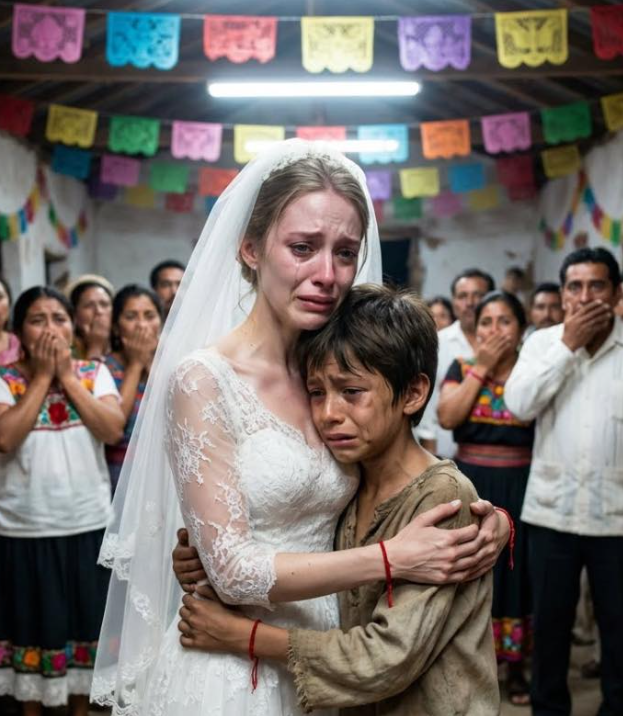
The boy’s name was Iktan, and he was ten years old.
He had no memory of parents, no face to attach to the word mother. His life began, as far as he knew, on a night of rain and overflowing water. When he was barely two, an old man named Don Eusebio—an elderly beggar who slept beneath a bridge near the La Viga Canal in Mexico City—found him drifting at the edge of a flooded ditch.
The child lay inside a cracked plastic basin, soaked, trembling, unable to speak or stand. He cried until his voice gave out, until his tears became silent.
Around his tiny wrist was the only clue to where he came from:
a faded red woven bracelet, frayed with age,
and a soggy scrap of paper, the ink almost erased, reading:
“Please… someone kind, take care of this child.
His name is Iktan.”
Don Eusebio had nothing to offer a child—no roof, no money, no certainty.
Only aching legs and a heart that still remembered compassion.
And yet, he took the boy.
He raised Iktan on whatever the streets could provide: day-old bread, donated soup, coins earned from collecting bottles. Nights were cold beneath the bridge, but the old man always wrapped the child in his own coat first.
As Iktan grew, Don Eusebio told him one thing again and again:
—If you ever find your mother someday… forgive her. No one leaves their child without breaking inside.
Iktan grew up among market stalls and shouting vendors, under open skies and concrete shadows. He never knew what his mother looked like. Don Eusebio only remembered details from that night—the bracelet, a long strand of black hair tangled in it, and a faint lipstick stain on the paper.
“She was probably very young,” Don Eusebio would say. “Too young to know how to stay.”
Years passed. Then the old man fell gravely ill, his lungs damaged beyond repair. He was taken to a public hospital, leaving Iktan alone for the first time.
Hungry and desperate, the boy began begging more than ever.
One afternoon, he overheard people talking about a grand wedding in Polanco—the wedding of the year, they said. With an empty stomach and a throat dry from the heat, Iktan followed the noise and lights.
He lingered near the gates of the mansion, watching tables heavy with food: mole, carnitas, pastries, cold bottles sweating in the sun.
A kitchen worker noticed him, softened, and quietly handed him a warm plate.
—Eat fast, kid. And stay out of sight.
Iktan thanked her and sat where he could see inside. Mariachi music filled the air. Men in tailored suits laughed. Women shimmered in silk and jewelry.
As he ate, a thought crossed his mind—small, fragile, dangerous:
See more on the next page
Advertisement
