The days that followed brought quiet but meaningful changes. I settled back into life on the property. Alexis and George ran the inn, while I focused on my own affairs. We crossed paths from time to time, exchanging polite but frosty words. The guests may have sensed the tension, but no one said a word.
I spent long hours in the paddock with the horses. They offered no judgment, no grudges—just the pure, simple acceptance only animals can give. Star became my steadfast companion. I shared with her the thoughts I couldn’t tell anyone else, and she would simply nuzzle me, as if she understood every word.
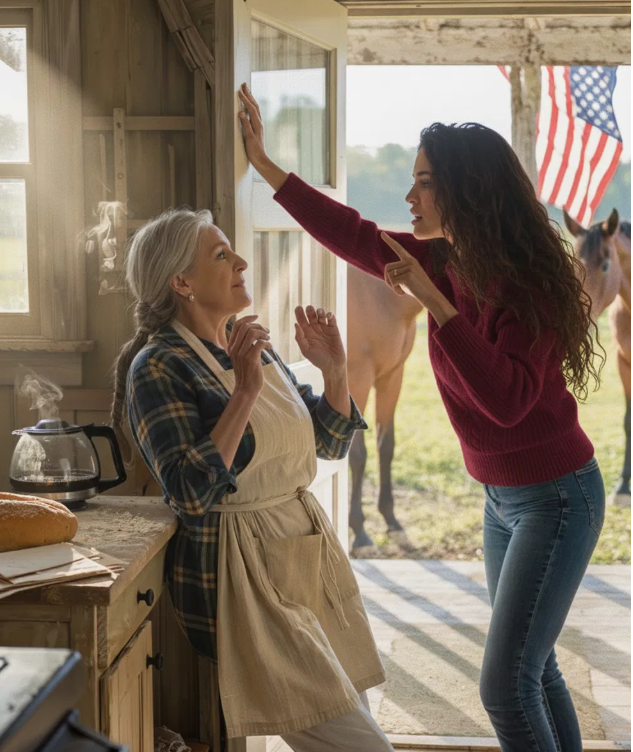
One afternoon, as I brushed Star’s mane, I heard footsteps behind me. Turning, I saw Alexis standing a few feet away, uncertain and hesitant.
“Can I talk to you?” she asked.
“Of course,” I replied, trying to keep my voice neutral.
She approached slowly, as if I were a wild animal that might bolt. We stood side by side, both looking at Star.
“I remember when we got her,” Alexis said softly. “I was six years old. Dad brought her home in an old trailer. She was just a scared, trembling colt, afraid of everything.”
“I remember,” I replied. “You insisted on sleeping in the barn that first night because you didn’t want her to be alone.”
A sad smile crossed Alexis’s face.
“You brought blankets and stayed with me all night, telling me stories, singing softly. You didn’t sleep a wink.”
“It was worth it. You were happy.”
We were silent for a moment. Then Alexis said, her voice low,
“I remember a lot of good things, Mom. It’s not that I forgot them. It’s just… the bad things got bigger, you know? Like they took up all the space in my head.”
I continued brushing Star’s mane, giving her time to find the words.
“The therapist gave me an exercise,” she continued. “She asked me to make a list of all the good things you did for me and another list of the bad things.” She paused. “The list of good things was three pages long. The list of bad things… half a page.”
I felt my heart clench.
“And still, half a page was enough to make you hate me.”
“I don’t hate you,” she said quickly, looking at me for the first time. “I never hated you. I was confused, angry, scared.”
“Scared of what?”
Alexis took a deep breath.
“Of becoming you. Of spending my whole life sacrificing myself, suffocating myself, never being anything more than a mother. When I looked at you, I saw a future that terrified me. And instead of talking about it, instead of processing those feelings, I just pushed you away.”
“But I never asked you to be like me,” I protested. “I wanted you to be happy, to have opportunities I never had.”
“I know that now,” she said, wiping away a tear. “But at the time, all I felt was pressure. The pressure to be grateful, to be the perfect daughter, to make up for all your sacrifices. And I knew I would never succeed. So I started to resent you for doing so much for me.”
The brutal honesty of those words left me breathless. But that was exactly what we needed, wasn’t it? Even if it hurt.
“And George,” she continued, “he saw my frustration and fed it. He said you were controlling, that I needed to be free. And I wanted to believe it because it was easier than admitting my own guilt.”
“Did you love him?” I asked, not knowing why that question mattered.
“I do love him,” she corrected. “I still love him. But now I see that our relationship was built in part on that rebellion against you, and that’s not healthy.”
Star nudged my hand with her muzzle as if asking me to keep stroking her. I obeyed, and the repetitive movement helped me organize my thoughts.
“Alexis,” I began carefully, “I accept that I may have been suffocating, that my love at times imprisoned you instead of setting you free. But that doesn’t justify what you did, the words you said, the way you treated me.”
“I know,” she whispered. “I know, and I have no excuse. That day when I said that thing about the nursing home and the paddock, I saw the light go out in your eyes. And I felt a terrible pleasure because I finally had power over you. But a second later, I felt a horror so great because I realized that I had become exactly the kind of person I always despised.”
She sobbed, covering her face with her hands.
“I became my father. I abandoned you the same way he abandoned me. And the worst part is that I knew I was doing it while I was doing it. And I did it anyway.”
I didn’t know what to say. Part of me wanted to comfort her, tell her everything was fine—but it wasn’t all fine. And pretending it was would be going back to the old patterns.
“What do you want from me now?” I finally asked.
Alexis lowered her hands, revealing a face ravaged by guilt.
“I don’t know if I have the right to want anything. But I would like the chance to get to know you for real. Not as the mother who raised me, not as the woman I pushed away, but as Sophia. The woman you are, with your own dreams, with a life that doesn’t revolve just around me.”
The answer surprised me. I hadn’t expected that.
“I don’t even know who that Sophia is,” I admitted. “I spent so long being a mother that I forgot how to be a person.”
“Then maybe we can discover it together,” she said, a glimmer of hope in her eyes. “No pressure, no expectations, just… trying.”
I looked at my daughter. She seemed smaller somehow, more vulnerable. I saw in her the six-year-old girl who slept in the barn and also the thirty-year-old woman who gave me the cruelest ultimatum. Both were Alexis. Both were part of her.
“All right,” I said slowly. “We can try. But with conditions.”
She nodded quickly.
“Anything.”
“First, total honesty. If something bothers you, you say it—without silent resentments building up until they explode.”
“Agreed.”
“Second, clear boundaries. You have your life. I have mine. We can love each other without living inside each other.”
“Yes,” she nodded, wiping her tears.
“And third…” I paused, because this was the hardest one. “You need to do individual therapy, not just the family sessions. You have things to resolve that have nothing to do with me, and you need to do it for yourself.”
Alexis was silent for a moment, then she nodded.
“I already started. After that first session, I looked for Dr. Laura and asked for private sessions. I go twice a week.”
I felt a surge of unexpected pride. My daughter was truly trying to change.
“And you, Mom?” she asked timidly. “Are you going to do therapy alone, too?”
The question caught me off guard. I hadn’t thought about it.
“You should,” Alexis said gently. “You have things to resolve, too. The way Dad left you, the years of struggle, everything you went through with me. You deserve that space to heal.”
She was right. Once again, my daughter was showing me something I didn’t want to see.
See more on the next page
Advertisement
