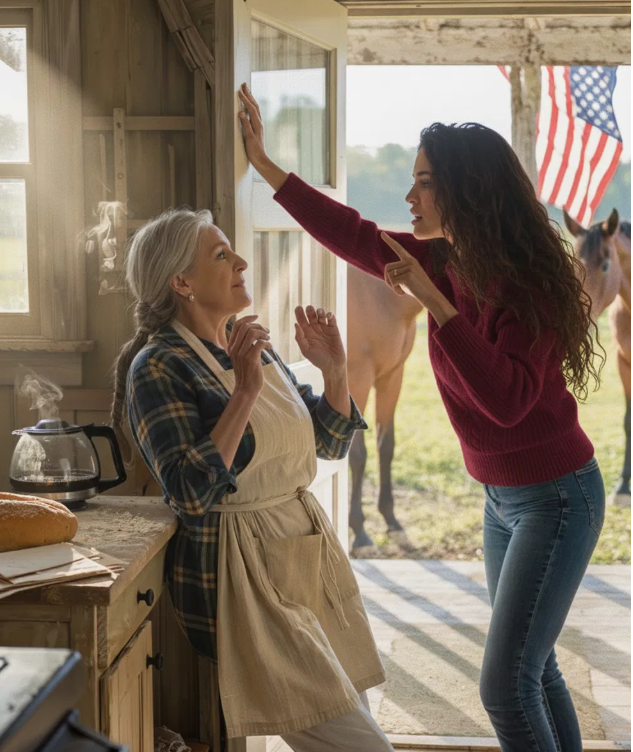
“George,” I replied, “I hope you use this opportunity well, because there won’t be another one.”
He nodded and walked away.
I returned to the property on a Thursday afternoon. Marcy insisted on coming along, and I welcomed her company—I needed someone by my side for that moment. The house looked both familiar and different. The cabins Alexis had built were attractive, I had to admit; she clearly had an eye for design. I suppose she got that from me.
But it wasn’t the cabins that caught my attention first. My gaze went straight to the paddock, where the horses grazed calmly. Star, the old mare, lifted her head as she spotted me and trotted over to the fence. I ran my hand over her muzzle, and tears began to spill from my eyes.
“I’m home,” I whispered to her. “I’m back.”
Marcy gently touched my shoulder.
“Do you want me to stay with you tonight?”
“No, friend. I need to do this alone. I need to reclaim this space, you know.”
She understood. She hugged me tightly and left, but not before making me promise to call if I needed anything.
I stepped into the house slowly, as if entering unfamiliar territory. Everything was neat and orderly. Alexis and George had left my real room—the one that wasn’t a storage closet—untouched. My belongings were exactly as I had left them months ago.
I sat on the bed and took it all in. This room carried so many memories. Sleepless nights rocking Alexis as a baby. Tears shed when Jim walked out on us. Dreams for a brighter future for my daughter. And yet, it had also been the place from which I had been cast aside, treated like a burden.
But now I was back. Legally, the house was mine again. Yet emotionally, it still felt like hostile ground.
I spent the rest of the day organizing, cleaning, trying to reclaim the space as my own. Alexis and George never appeared; they were probably in one of the cabins, keeping their distance. For now, that was for the best. We all needed time to process what had happened.
The first therapy session was set for the following Monday. Dr. Laura Scott, a specialist in family conflict, had been personally recommended by Mr. Carlos. He assured me she was both firm and compassionate—the balance we desperately needed.
Sunday night brought little sleep. I imagined the session over and over. What would I say? What would Alexis say? Would she even show up, or would she find some excuse to skip it?
On Monday morning, I dressed carefully, choosing a light green blouse that Alexis had always liked on me. I knew it was a small, almost pathetic attempt to reconnect, but I couldn’t help it.
Dr. Laura’s office was in an old house converted into a clinic downtown. I arrived fifteen minutes early. Alexis and George arrived right on time, not a second more or less. We exchanged only a nod—no words. The tension in the air was thick.
The receptionist led us to a spacious, cozy room with plush sofas and décor designed to soothe. Dr. Laura, a woman in her fifties with gray hair tied back in a bun and sharp eyes behind red-rimmed glasses, greeted us warmly and invited us to sit. I chose an armchair; Alexis and George took the sofa farthest from me. The seating arrangement alone spoke volumes about the state of our relationship.
“Well,” Dr. Laura began in a soft but firm voice, “I appreciate everyone’s presence. I know being here wasn’t an easy choice, especially under the current circumstances, but the fact that you agreed to come is already an important first step.”
Alexis scoffed softly. The therapist heard it but didn’t comment. She just continued.
“Our sessions will follow some basic rules. First, each person will have their turn to speak without interruptions. Second, there are no judgments here, just listening and an attempt to understand. Third, everything that is said in this room stays in this room, unless it’s something that poses an immediate risk to someone.”
She paused, observing us.
“To start, I would like each of you to tell me, in a few words, what you hope to gain from these sessions. Sophia, would you like to begin?”
I took a deep breath.
“I hope we can find some way to coexist. I don’t expect things to go back to the way they were. That’s impossible. But I hope we can at least respect each other. And maybe, who knows, Alexis can understand how much she hurt me.”
The therapist nodded and turned to my daughter.
“Alexis?”
She remained silent for a long moment, then said in a harsh voice, “I’m only here because I was forced. I don’t expect anything because I don’t believe these sessions are going to change anything. My mom has always been dramatic, always played the victim. This is just one more chapter in that story.”
Her words were like slaps in the face. Dr. Laura wrote something in her notebook but maintained a neutral expression.
“George?” she asked.
He seemed uncomfortable.
“Look, I just want to resolve this so we can move on with our lives. The inn is starting to do well. We have guests booking, but all this tension is ruining everything.”
“I understand,” said Dr. Laura. “So here we have three different perspectives. Sophia seeks understanding and respect. Alexis is skeptical and feels coerced. George wants to resolve the practical situation. All are valid perspectives.”
She leaned forward.
“But before we talk about the future, we need to understand the past. Sophia, can you tell me briefly how we got here?”
And then I started talking. I recounted Jim’s abandonment, the years of raising Alexis alone, the sacrifices. I talked about her marriage to George, about how I was gradually pushed into a corner. I talked about the fraudulent property transfer, about how I was tricked. And I talked about that day—the day of the ultimatum.
“She told me,” my voice trembled, “that I had to choose between the nursing home or sleeping with the horses in the paddock, as if I were an animal. As if sixty-two years of life, of love, of dedication meant nothing.”
Alexis exploded.
“You’re twisting everything. I never—”
“Alexis,” Dr. Laura interrupted firmly. “Do you remember the rule? Everyone speaks in their own time. You will have your opportunity.”
My daughter crossed her arms, furious, but she fell silent.
I continued, now with tears streaming down my face.
“In that moment, when she gave me that choice, something died inside me. It wasn’t my love for her—that never died. It was my self-respect, my dignity, which I had slowly let die over all those months of humiliation. And I realized I needed to choose, not between a nursing home and a paddock, but between continuing to be trampled on or standing up and fighting for the minimum respect I deserved.”
When I finished, the silence in the room was heavy. Dr. Laura handed me a box of tissues. I wiped my tears, trying to regain my composure.
“Alexis,” the therapist said gently, “it’s your turn. Tell your version.”
My daughter took a deep breath. When she started talking, her voice was charged with anger. But there was something else there. There was pain, too.
“My mom has always been like this. Always playing the martyr. ‘Oh, I worked so hard for you. Oh, I sacrificed so much.’ As if I asked for it. As if it were my fault she stayed with a man who ran away.”
Every word was a stab, but I forced myself to listen without interrupting.
“She never let me grow up,” Alexis continued, “always suffocating me with that possessive love. When I met George, she didn’t like him from the start. I saw it in her eyes—that silent judgment. And when we decided to live together, she made all that drama.”
“I never made drama,” I couldn’t contain myself.
See more on the next page
Advertisement
