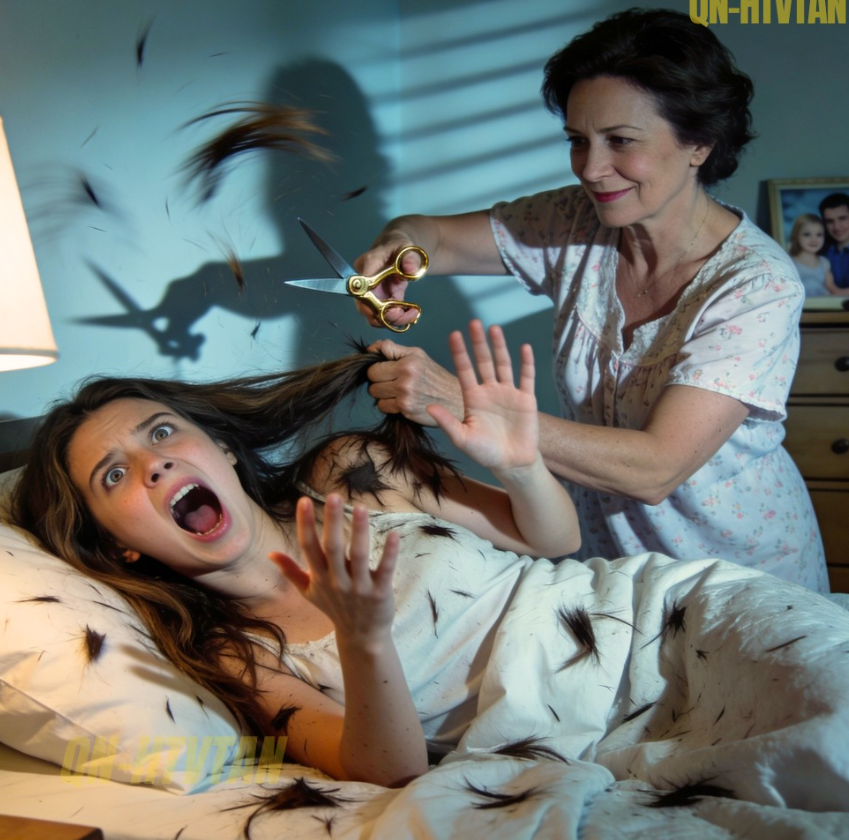
I woke to the cold touch of air brushing against the back of my neck. For a few seconds, I couldn’t place what felt wrong—only that something was missing. The room was dim, lit faintly by the soft yellow glow of the streetlamp outside my window. The air smelled faintly metallic, sharp and strange. Then I reached up, half-asleep, to push my hair out of my face. My fingers didn’t meet what they should have.
Instead, they brushed over uneven ends—jagged, harsh, wrong.
I sat up so fast the sheets tangled around my legs. My pulse pounded in my ears as I looked down. Strands of hair—long, chestnut, and familiar—covered the pillowcase and spilled down onto the floor. For a second, I couldn’t move. I just stared. Then the realization hit like a physical blow.
My hair.
I scrambled out of bed, nearly tripping on the blanket as I stumbled toward the mirror across the room. The face staring back at me didn’t look like mine. My once long, carefully cared-for hair—the one thing I’d quietly loved about myself—was uneven, hacked off at random angles. Some pieces barely reached my chin while others clung stubbornly to my shoulders. It wasn’t just a bad haircut. It was deliberate. It was mean.
My chest tightened. The mirror reflected someone who looked small, humiliated, and half-erased. I turned toward my desk—and that’s when I saw it.
The scissors. My mother’s old pair with the gold handles, sitting neatly beside a sticky note in her handwriting.
Don’t worry. Short hair makes you less noticeable. Today is Emma’s day. Don’t be selfish. – Mom
For a long moment, the world went silent. Then something inside me cracked—not loudly, but quietly, like thin glass under pressure. I picked up one of the fallen strands from the carpet and felt my throat tighten. I didn’t cry. Not right away. I just sank to my knees, clutching the hair in my hands as if holding it could make it all come back.
That was the moment I understood something I’d ignored my entire life: sometimes the people who are supposed to love you don’t just fail to see you—they try to erase you.
My name is Lana. I’m twenty-three years old. And this was not the first time my family had taught me my place.
We were a family of four—my parents, my younger sister Emma, and me—but it always felt like there were only three of them and then me, hovering at the edges. Emma had been the star from the moment she was born. She had big blue eyes, a perfect smile, and the kind of charm that pulled people in like gravity. My mother adored her. My father couldn’t stop talking about her.
“Emma’s so graceful,” my mother would say proudly. “She’s taking ballet now.” Or, “Emma got invited to another birthday party! She’s such a social butterfly.”
And me? I was quiet. Bookish. I drew, I read, I kept to myself. When relatives came to visit, my mother would parade Emma around like a showpiece. If anyone asked about me, she’d wave her hand dismissively. “Oh, Lana’s fine. She’s our calm one. Doesn’t like attention.”
That wasn’t true. I didn’t hate attention. I just wasn’t allowed to have it.
Emma had ballet lessons, piano lessons, and a new dress for every recital. I had hand-me-downs and a stack of library books. While she was showered with praise, I learned early that invisibility kept the peace.
Even my accomplishments didn’t count unless they somehow benefited Emma. When I brought home straight As, my mother’s only comment was, “That’s good, but maybe help your sister with her homework. She’s struggling in math.”
When I got accepted into the top tier of my university, she barely looked up from her phone. “That’s nice, dear. But don’t brag about it at dinner. Emma just went through a breakup.”
It was always Emma’s day.
The night before her high school graduation, I stayed up late ironing my navy dress. It was simple but elegant, the first thing I’d ever bought for myself with the money I earned at my part-time job. I wanted to look nice—not to outshine Emma, but to finally feel like I belonged in my own family’s photograph.
I’d spent months growing out my hair, learning how to style it, taking quiet pride in the small things I could control. It was the one feature my mother used to compliment before she decided it was “too much.”
But that night, I’d thought she was asleep.
She must have come in while I was dreaming of how tomorrow would go—the ceremony, the family photos, maybe a rare smile from her. I’d imagined her telling me she was proud. Instead, I woke to the soundless violence of scissors cutting through strands of me I didn’t know I’d been holding onto so tightly.
I kept replaying it in my head as the early light started to pour through the window. Did she stand there long? Did she hesitate at all? Or did she just cut, strand after strand, like she was trimming a hedge—tidying up her perfect family image?
Because that’s what I’d been to her. A distraction. A background character who could ruin the picture if I stood too close.
Emma’s graduation morning arrived like a cruel joke. My parents were already downstairs, laughing with relatives, celebrating the day. The smell of pancakes drifted through the air. Normally, that smell made me think of home, of comfort. That morning it made me sick.
I avoided their eyes when I came down, wearing a hat to cover the damage. My mother glanced up briefly, then smiled as if nothing had happened. “Good, you’re awake,” she said. “Don’t be late getting ready. We need to leave by ten.”
I waited for her to mention my hair, for even a flicker of guilt to cross her face. Nothing. She just turned back to her coffee.
Emma came down a few minutes later, radiant in her white dress, hair cascading in perfect curls. She looked like the kind of daughter my parents always wanted. She spotted my hat and frowned. “What’s with the cap? You’re not wearing that to the ceremony, are you?”
My mother’s voice floated from the kitchen. “Leave her be, Emma. She’s just having one of her moods.”
Moods. That’s what they called my silence, my boundaries, my pain—just moods.
I excused myself, pretending I needed to grab something from my room, and once I was out of sight, I locked the door. I stared at my reflection again, at the uneven haircut, the hollow eyes staring back. For years I’d thought if I was quiet enough, obedient enough, good enough, maybe I’d earn their love. But that night had proven it wasn’t about love. It was about control.
The sticky note was still on the desk. Don’t be selfish.
I picked it up, reading the words again and again until they blurred. The letters looked almost childish, written by the same hand that used to pack my lunches and tie my shoelaces. But now those same hands had held scissors to my head while I slept.
It wasn’t about hair. It never was. It was about taking something from me—something visible, something that might make me feel confident, radiant, alive. Because confidence would make me stand out, and standing out was Emma’s job.
I sat on the edge of the bed, the morning sun creeping up the walls, and I thought about every moment that had led to this one. Every comment disguised as concern. Every compliment with a barb hidden inside. Every time they told me to shrink so Emma could shine brighter.
They’d succeeded for years. But as I ran my hand over the rough ends of my hair, I realized something quietly powerful—there was nothing left for them to take that I wasn’t willing to reclaim.
The scissors were still there on the desk, glinting in the light. My mother’s note fluttered beside them. I folded it once, slowly, and slipped it into my pocket.
And that’s when I knew—this time, I wasn’t going to stay quiet.
Continue below
I woke up in the middle of the night with a freezing chill crawling down my neck. A strange emptiness spread from the back of my head as if something had been silently taken away. The room was dim, but I could still catch a faint metallic scent, sharp, bitter, and familiar.
My trembling hand reached for my neck. And then I saw them long, dark chestnut strands scattered across the pillow like remnants of a soul that had just been severed. I jumped out of bed, my heart racing erratically. My footsteps dragged across the carpet as if my body had lost all weight, stopping in front of the mirror. The mirror didn’t lie.
See more on the next page
Advertisement
