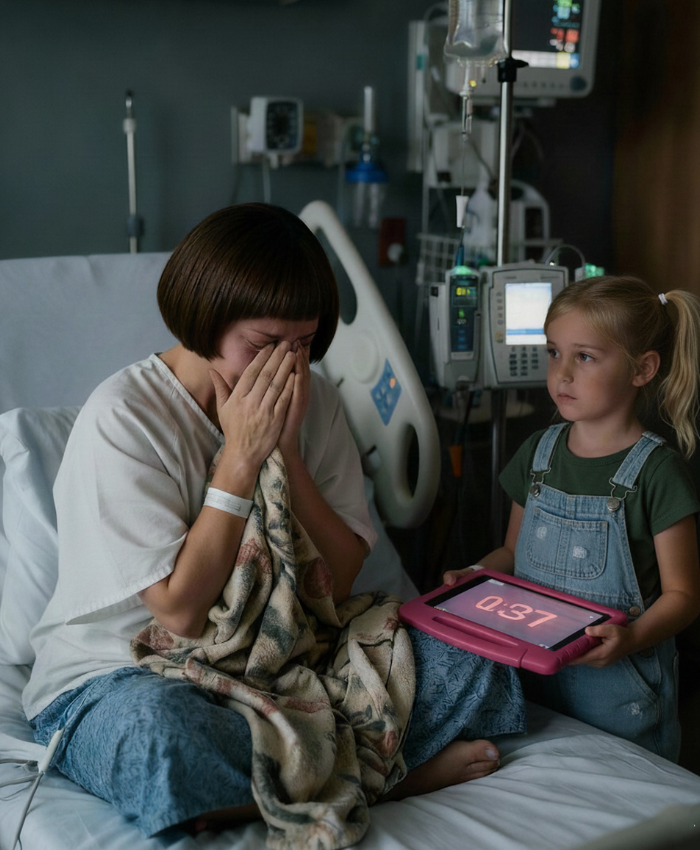
My name is Mara. For seven years, my life had been defined by quiet, domestic contentment. I married Jace—a man whose warmth matched his ambition. He worked as a sales manager for a pharmaceutical company, a demanding role, yet he always made our family his priority. Our five-year-old daughter, Nira—bright, joyful, with my eyes and Jace’s smile—was the center of our world.
Now eight months pregnant, I was expecting a baby boy. Nira was thrilled about becoming a big sister. Every night, she pressed her cheek against my belly and whispered little secrets to her brother. I had once worked as a nurse, a career I loved, but after Nira was born, I chose to stay home with her.
I never once regretted it. Time with my family felt more valuable than anything else.
Jace was especially present on weekends. We spent our days on park picnics, movie outings, and small adventures chosen just to make Nira laugh. He’d hoist her onto his shoulders as we walked, his laughter carrying through the trees, and he was always attentive to me. Since this pregnancy, he’d become even more protective, refusing to let me lift anything heavier than my purse.
But around my fifth month, my health began to decline. I felt dizzy often, battled constant nausea that went far beyond morning sickness, and suffered crushing headaches that sometimes blurred my vision. I saw my OB/GYN, but nothing unusual showed up. The doctor attributed it to a difficult pregnancy. Jace reassured me, saying it was just something we had to get through. I blamed myself, convinced my body was failing me.
Through it all, Jace appeared unwaveringly supportive. Every morning, he set out a careful lineup of supplements—prenatal vitamins, iron, and a few herbal capsules he said would ease the nausea. He’d smile and say, “Take these, you’ll feel better.” He cooked more often too, gently insisting I rest while he took over. Watching him in the kitchen, telling me not to worry, I felt lucky to be so cared for.
Still, a quiet unease had begun to settle in my chest. Jace had started taking phone calls late at night, slipping out of our bedroom and speaking in hushed tones in the living room. When I asked, he brushed it off as work—clients in different time zones. His trips to the office on weekends had increased as well. He claimed he was just picking up paperwork, yet sometimes he’d be gone for hours. And though I couldn’t explain it, something about it all felt… wrong.
One afternoon, Nira squeezed my hand and whispered, “Daddy is always talking to someone.”
I gently stroked her hair and said, “Daddy’s just busy with work, sweetheart.” She nodded, but worry lingered in her eyes. I didn’t think much of it. Jace was responsible—probably handling an important project. He was working hard for us. At least, that’s what I told myself.
Inside me, the baby kicked and shifted, lively and strong—a constant reassurance. Just a little longer, I thought. Soon we’d meet him. Nira, Jace, and I were all waiting to welcome one more heart into our family. I believed we were whole. I believed our happiness was solid, permanent.
I didn’t know then how fragile it truly was.
Two weeks before my due date, I woke to sudden, stabbing pain. My stomach tightened in steady waves. I knew instantly—this was labor.
“Jace, it hurts! The baby’s coming!” I shook him awake.
He jolted upright, startled, then forced calm into his voice. “It’s okay. We’ll go to the hospital.” He squeezed my hand.
But instead of moving, he hesitated. “Wait—I need to grab something,” he said, leaving the room.
I stayed on the bed, breathing through the pain. Minutes dragged on—twenty of them. The contractions intensified, closer and sharper. “Jace, please hurry,” I called, but there was no answer. I heard drawers opening, papers rustling in the living room. What is he doing? My thoughts blurred with pain. All I wanted was to reach the hospital.
More than half an hour later, he finally returned. “Sorry. I was looking for the insurance card,” he said, his voice oddly flat—nothing like the urgency tearing through me.
On the drive, the pain became unbearable. Jace drove slowly, carefully. Too carefully.
“Please, hurry,” I begged.
“We need to be safe,” he replied without looking at me.
When we arrived, I could barely stand. Supported by Jace, I reached the maternity ward. Nurses rushed over with a wheelchair and took me straight to an exam room. The moment the doctor checked the ultrasound, his face stiffened.
See more on the next page
Advertisement
